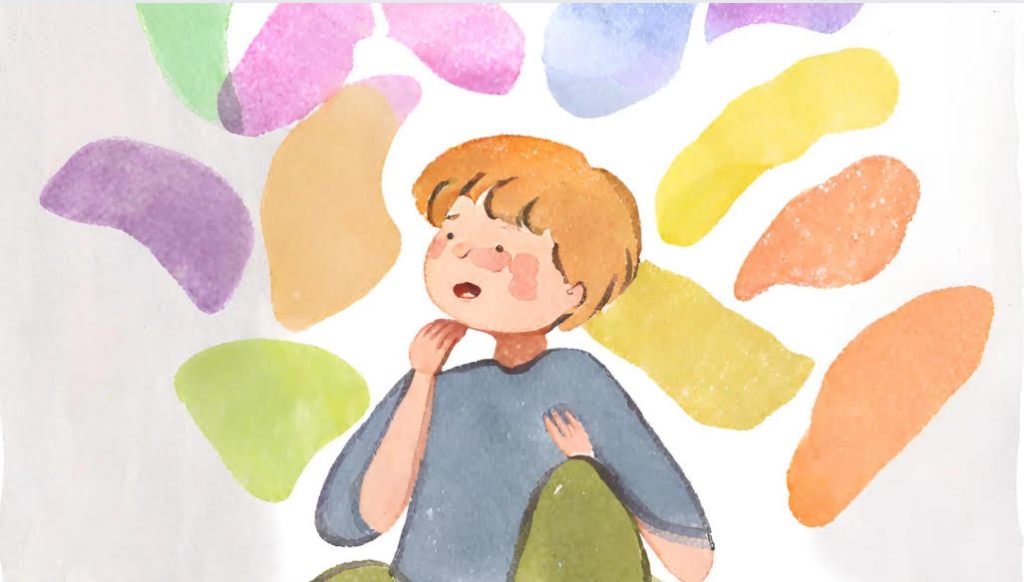
Written by Srivalli Adarapu | Art by Lily Ozaeta
First conceptualized in 1911 by German psychiatrist Eugen Bleuler, Autism spectrum disorder (ASD) is a prevalent neurodevelopmental disability found in around 1 in 36 children, according to CDC. Once linked to fantasies and hallucinations by Bleuler and subsequently detached from such associations in the 1960s, autism is now understood as a developmental disability associated with a variety of challenges relating to social behavior and communication. Although our understanding of autism has significantly advanced, much about this disorder remains unknown.
ASD is identified as a “spectrum” disorder because of the diversity in its symptoms. Sensory sensitivities to stimuli such as sound, taste, light, smell, and touch are common for autistic individuals. Autism is also accompanied with a variety of social challenges with communication and behavior. Those experiencing autism may display repetitive and impulsive behaviors, misunderstand and inappropriately use facial expressions and gestures, and disregard other’s emotions. They also frequently face learning and speaking challenges.
Although ASD is difficult to diagnose due to the lack of medical tests, it can be detected based on a child’s behavior and development. It is generally identified at the age of two or three. However, many are diagnosed later on in their lives and do not receive the necessary support and help they require. Therefore, early intervention is vital to ensure that autistic individuals are provided with guidance and support.
Autism is known to result from a variation of genetic and environmental risk factors rather than a singular cause. Scientific research has proven that autism tends to run through families. Certain gene changes serve as genetic risk factors for autism; If they are passed down from a parent to a child, it increases the child’s susceptibility of acquiring autism. Environmental risk factors also increase the susceptibility of autism. These risk factors include elderly parent age and birth complications. These genetic and environmental risk factors can result in autism by impairing neurons and consequently affecting early brain development. Ongoing research endeavors strive to identify the definitive causes for autism.
While autism is a lifelong condition, treatment interventions can address and alleviate symptoms. Treatment options include therapy for speech, language, and cognitive behavior.
Unfortunately, many aspects of autism, including its underlying causes, remain unexplained. Fortunately, ongoing research efforts tackle the many uncertainties about autism, holding the potential to revolutionize our understanding of autism. Through increasing public understanding and awareness, we can foster a supportive community and facilitate early diagnosis, ensuring that autistic individuals receive the essential support and guidance they require.
Works Cited:
Evans, Bonnie. “How autism became autism: The radical transformation of a central concept of child development in Britain.” History of the human sciences vol. 26,3 (2013): 3-31. doi:10.1177/0952695113484320
Autism Speaks. “What Is Autism?” Autism Speaks, 2024, www.autismspeaks.org/what-autism.
NHS. “What Is Autism?” NHS Choices, NHS, 2022, www.nhs.uk/conditions/autism/what-is-autism/.

 pathoscribe
Leave a comment