Written by Jayne Thakur | Art by Maya Wen
As is with all auto-immune disorders, Multiple Sclerosis (MS) is a disorder in which our bodies begin attacking our healthy cells. In these conditions, the body’s immune system is unable to distinguish between foreign antigens against the body’s own cells.
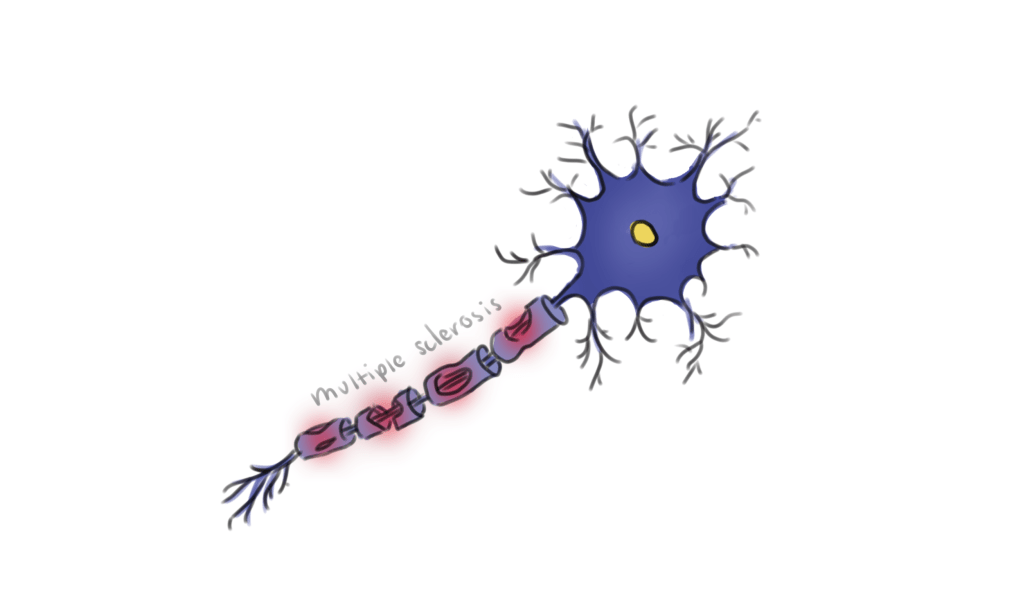
MS is caused by a malfunction within the central & peripheral nervous systems: damage to the Myelin Sheath. Throughout our body, we possess nerve cells, called neurons, which transmit electrical messages from the brain to various organs, stimulating them to work. To increase the speed of transmission, the axon of a neuron is often myelinated, or covered in a fatty substance called the Myelin Sheath, but due to MS, the immune system attacks it, leaving neurons with scar tissue called Sclerosis. In the absence of the Myelin Sheath, the transmission of brain signals is slowed down, resulting in a disparity between the release and receival of the neural signs.
A person diagnosed with MS may undergo various symptoms; it presents itself differently in many people due to the span of its impact. Impairment of brain signals is rather vague, and ends up affecting different organs and organ systems depending on which neurons have been de-myelinated. Initially, people may have vision problems, such as blurred or double vision, or even pain associated with the swelling of the optic nerve. Later, more severe symptoms may appear, such as muscle fatigue, trouble with balance & coordination, numbness, speech or hearing issues, etc. On top of these, nearly 50% of MS patients end up with some sort of cognitive impairment, albeit mild. While there is a range of symptoms, it is best to approach a healthcare provider to seek assistance navigating the illness.
However, treatment is in development for MS: currently, there are 2 major areas of treatment. One targets the long-term effects of the disease, while the other focuses on preventing each attack of MS. Anti-inflammatories, steroids, and PLEX are all potential options to explore after diagnosis. Neither has the potential to entirely cure the ailment, but will definitely help ease the systems and allow patients to approach normality in their lives. It is important to seek advice from medical professionals to help maintain standard of life past diagnosis.
Sources:
Johns Hopkins University. “Multiple Sclerosis (MS).” Johns Hopkins Medicine, 2024, www.hopkinsmedicine.org/health/conditions-and-diseases/multiple-sclerosis-ms. Accessed 25 March 2024.
Johns Hopkins University. “What Are Common Symptoms of Autoimmune Disease?” Johns Hopkins Medicine, 22 July 2022, www.hopkinsmedicine.org/health/wellness-and-prevention/what-are-common-symptoms-of-autoimmune-disease. Accessed 25 March 2024.Verma, Avi. “Autoimmune Diseases: Types, Symptoms, Causes, and More.” Healthline, Healthline Media, 4 Mar. 2024, www.healthline.com/health/autoimmune-disorders#common-autoimmune-diseases. Accessed 25 March 2024.



 pathoscribe
Leave a comment