Written by Harini Sivanandh Ramadass | Art by Harini Sivanandh Ramadass
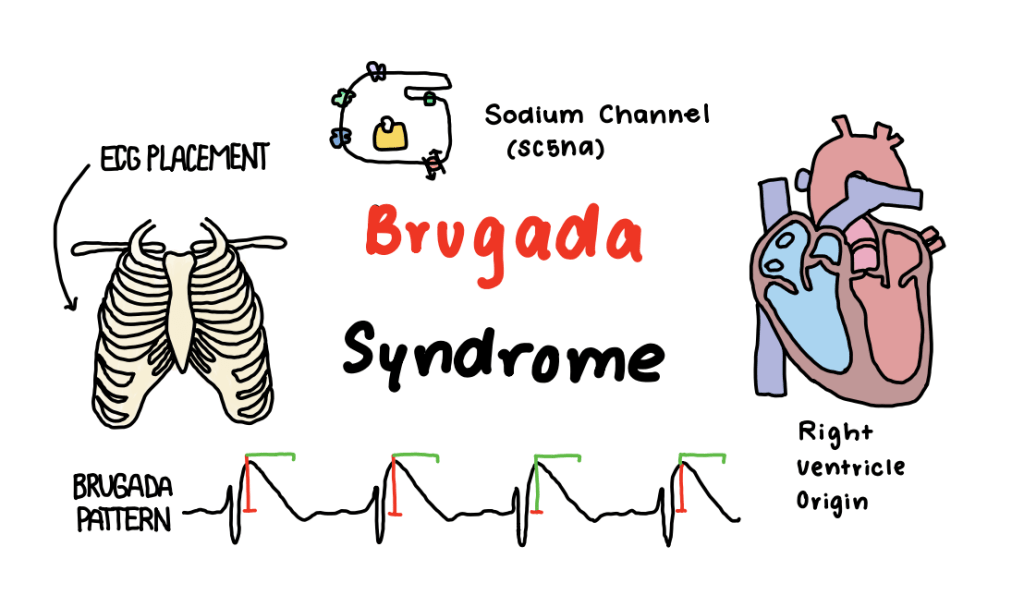
The heart, the pulses of life, deems to be one of the most important organs in the human body. Yet, there is a sly anomaly that interferes with the heart’s notation; Brugada Syndrome is a fatal condition where improper coordination among the electrical impulses results in sudden cardiac arrest. As Cedars-sinaai states, “Brugada syndrome is rare. It affects about 5 of every 10,000 people worldwide”. Brugada Syndrome is a rare anomaly for which we should educate ourselves with its causative factors and symptoms, so we can come up with appropriate management strategies, to help the lone few who suffer with it.
Brugada syndrome can be caused by mutations in certain genes responsible for regulating sodium channels in the heart. These mutations disrupt the normal flow of sodium ions, causing irregular heartbeats and increasing the risk of arrhythmias otherwise known as an abnormal heartbeat. Although the exact cause of these mutations is not always known, they can be inherited from one or both parents, or they can occur spontaneously. Therefore, this condition has many starting points, people with or without a past cardiac problem can have varying symptoms as discussed below.
Symptoms of Brugada syndrome vary widely; as some people have no symptoms at all and have no history of heart problems, while others may experience fainting, palpitations, or cardiac arrest. These symptoms usually occur during rest or sleep when there is no stress on the heart. In some cases, Brugada syndrome can be discovered unexpectedly during a routine physical exam or after a sudden cardiac event, so the origin is not always easy to trace. This is a type of condition that is mainly triggered by an outside source, before it creates havoc inside the body.
The treatment of Brugada syndrome involves many methods designed to reduce the risk of dangerous cardiac arrhythmias and cardiac arrest. Avoiding triggers is an important aspect that may worsen the disease, such as certain medications, fever, or excessive alcohol consumption. Triggers are the main cause that can affect a person that has no history of cardiac problems to therefore awaken this condition. In extreme cases, an implantable cardioverter-defibrillator (ICD) may be used to monitor and treat potentially life-threatening heart arrhythmias. Additionally, patients with Brugada syndrome may benefit from regular visits to a cardiologist and genetic counseling to halt the threat from its beginning. These are all possible treatments to stop the harmful effects of Brugada Syndrome, a condition that has no start or end, and is only awakened through a trigger, a trigger that defines the patient’s future heart health.
Brugada syndrome is a serious heart condition that requires careful treatment to reduce the risk of cardiac arrest and other heart complications, a sly anomaly that originates from generational genes. Early diagnosis and appropriate treatment are critical to improving the diagnosis and ensuring the health of patients with Brugada syndrome, whilst avoiding harmful triggers that can aggravate their condition. Raising awareness for this condition is crucial for early detection and intervention that can ultimately save lives and promote heart health for those who may unknowingly host this condition.
Works Cited
El Sayed M, Goyal A, Callahan AL. Brugada Syndrome. [Updated 2023 Aug 8]. In: StatPearls [Internet]. Treasure Island (FL): StatPearls Publishing; 2024 Jan-. Available from: https://www.ncbi.nlm.nih.gov/books/NBK519568/
“Brugada Syndrome.” Mayo Clinic, Mayo Foundation for Medical Education and Research, http://www.mayoclinic.org/diseases-conditions/brugada-syndrome/symptoms-causes/syc-20370489. Accessed 7 May 2024.
 pathoscribe
Leave a comment