Written by Sophia Qin | Art by Tanisha Arora
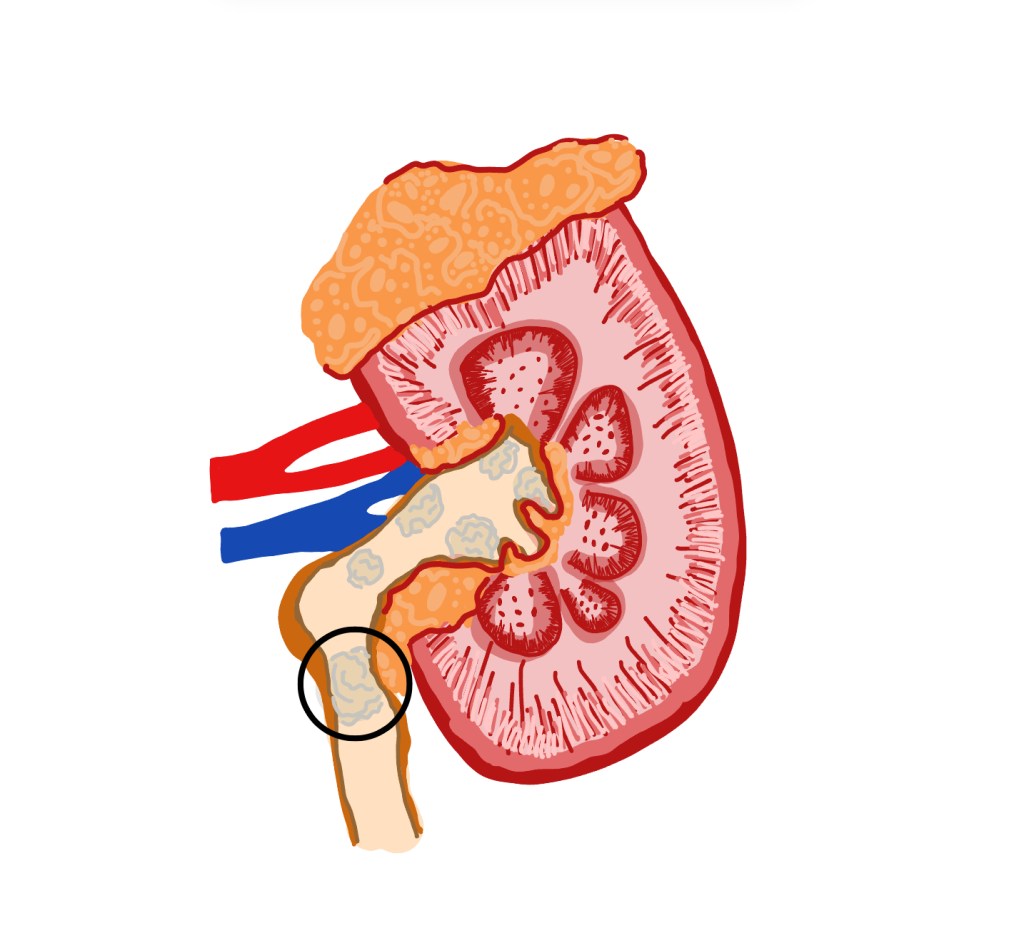
Medically known as renal calculi, kidney stones is a common disorder that results when hard deposits of minerals and salts form in the kidney. The size and severity of these deposits vary, but all cause severe discomfort and pain to the individual. In the United States alone, approximately 9 percent of the population contract kidney stones once in their lifetime: this equates to 1 in 11 people. The prevalence of kidney stones has been rapidly increasing, with many health experts blaming the poor lifestyle habits and overly saturated diets. Kidney stones are more common in adults from ages 30 to 60. Men are often more affected by this disorder than women, with over two times more men contracting the disease compared to women. However recently, this gap has been narrowing as more women have been contracting kidney stones due to unhealthy lifestyles.
The formation of kidney stones is complex and it begins with an imbalance of the substances that constitute the urine. Minerals and substances such as calcium, uric acid, and oxalate build up and concentrate until the fluid in the urine can no longer dilute it, leading to the formation of crystals. When more and more crystals form, they begin to stick together and grow into larger stones. There are many causes for kidney stones, with lifestyle and dietary habits being a primary contributor to its development. Dehydration increases concentration of stone-forming substances and a high intake of protein, sugar, and sodium also promotes stone formation. Certain medical conditions such as urinary tract infections (UTIs) and hyperparathyroidism can also increase risk of developing kidney stones.
Symptoms of kidney stones fluctuate and are dependent on the size and location of the stone, with smaller stones causing minor pain and larger ones resulting in medical intervention. Oftentimes, patients experience severe pain below the ribs, back, lower abdomen, and groin. Painful urination, nausea, vomiting, fever, and chills are also present in patients with larger stones in their kidney. Similar to its symptoms, the duration of kidney stones vary by size and location. Smaller stones pass within a couple of days or weeks while larger ones remain in an individual’s kidney unless medically removed.
Medical treatments for more severe cases of kidney stones are typically invasive but non-invasive procedures can be used. An example of an invasive procedure is ureteroscopy, which involves the insertion of a thin scope into the ureter to retrieve the stone and remove it. In contrast, extracorporeal shock wave lithotripsy (ESWL), a completely non-invasive procedure, uses sound waves to break the stones up into smaller pieces that allow for reduced symptoms and a quicker passing. Preventive measures are also just as crucial in regulating and managing kidney stones. Moderating salt and liquid intake is vital in reducing the probability of contracting the disorder and leading a healthy life.
Work Cited:
“Kidney Stones – Symptoms and Causes.” Mayo Clinic, http://www.mayoclinic.org/diseases-conditions/kidney-stones/symptoms-causes/syc-20355755#:~:text=Kidney%20stones%20.
Scales, Charles D., et al. “Prevalence of Kidney Stones in the United States.” European Urology, vol. 62, no. 1, July 2012, pp. 160–165, http://www.sciencedirect.com/science/article/pii/S0302283812004046, https://doi.org/10.1016/j.eururo.2012.03.052.
Gillams, Kathryn, et al. “Gender Differences in Kidney Stone Disease (KSD): Findings from a Systematic Review.” Current Urology Reports, vol. 22, no. 10, 2021, p. 50, http://www.ncbi.nlm.nih.gov/pmc/articles/PMC8497339/, https://doi.org/10.1007/s11934-021-01066-6.
 pathoscribe
Leave a comment