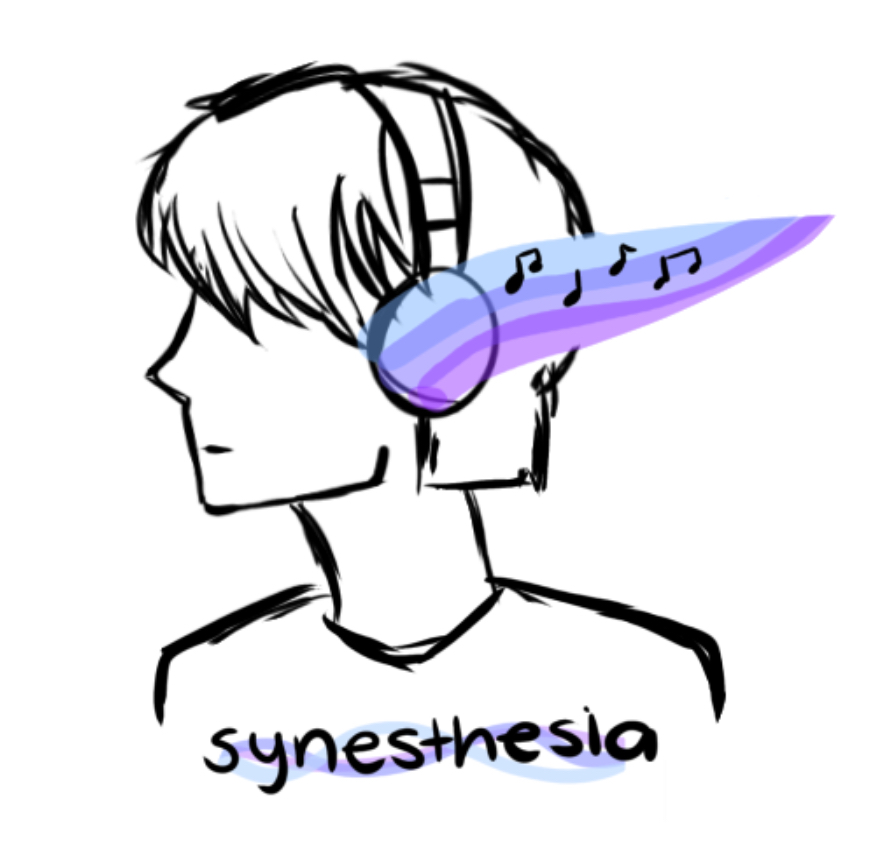
Written by Kirsten Batitay | Art By Anoushka Pandya
For most of us, the world has been filled with color since we opened our eyes and has continued to remain that way until now. However, for people with certain forms of synesthesia, color can be present in parts of life that one usually wouldn’t imagine, like listening to music or seeing numbers.
Although it might be commonly misconstrued as a medical condition, synesthesia is when one’s brain processes sensory information through multiple senses, causing them to experience various senses simultaneously. Because of this, some have described it as having “wires crossed” in their brain. Often starting in childhood, at least 4% of people worldwide experience this phenomenon, but the number may be higher as it is so natural for some that they don’t realize they have it.
Then, if synesthesia isn’t a disorder or disease, how does it happen? Normally, our brain interacts with our senses because our senses first detect something happening around us. These senses send the brain signals describing their experience, and when the brain receives them, it routes them to a processing area. This area then connects to others that help us understand what we’re experiencing. Synesthetes, people who experience synesthesia, process those signals differently in that they simultaneously process the same information through multiple areas of the brain. This occurrence causes a primary and at least one secondary effect.
A primary effect, or normal response, is what you experience due to sensory input, like hearing sounds and recognizing them as music. Synesthetes experience a secondary effect in which it seems as though another sense is working when there is no input from that sense. An example of this would be hearing music because you see colors.
Within our five main senses, we have perception abilities, which are the various factors that you can identify with each sense. Some perception abilities for sight include shapes, textures, and shapes. Because there are a variety of possible combinations between your senses and their perception abilities, there are at least 60 known forms of synesthesia! Some well-known forms include auditory-tactile and mirror-touch. Auditory-tactile synesthesia occurs when sounds cause you to feel touch-based sensations, and mirror touch synesthesia occurs when one sees something happen to another person and physically feels it as well even though they are not experiencing that stimulation.
Although the exact reason why synesthesia happens is unknown, it has been categorized into three main types: developmental, acquired, and drug-induced. Those with developmental synesthesia are neurodivergent, meaning their brain development and function are different from that of a neurotypical person, whose brain development and function are as expected. Acquired types occur when the brain is damaged, causing synesthesia. As the name implies, drug-induced synesthesia is brought on by the nonmedical use of drugs like hallucinogens.
While both developmental and acquired synesthesia do not require treatment, drug-induced synesthesia might indicate that a person needs treatment for a drug overdose. It is also important to note that developmental and acquired types cannot be prevented and that synesthesia is uncontrollable.
Sometimes, we see social media posts about those with synesthesia, and we’re amazed at how their brains work. Those who experience this have shown better memory abilities related to their form of synesthesia and tend to score higher on intelligence measurement tests. With the very nature of this phenomenon, it is no surprise that those who have it are more likely to choose creative careers. Some well-known music artists with synesthesia are Beyoncé, Duke Ellington, and Billy Joel.
This proves that our bodies and brains can work in many wondrous ways, and researchers and scientists continue to uncover these unknowns. Phenomena and conditions like synesthesia are testaments to our strengths as humans and prove that even things that seem to be weaknesses or mysteries can become our greatest assets should we choose to embrace them.
Sources:
Banissy, Michael J, et al. “Synesthesia: An Introduction.” Frontiers in Psychology, U.S. National Library of Medicine, 15 Dec. 2014, http://www.ncbi.nlm.nih.gov/pmc/articles/PMC4265978/#:~:text=No%20use%2C%20distribution%20or%20reproduction,Saenz%20and%20Koch%2C%202008.
Professional, Cleveland Clinic medical. “Sense and Sense Abilities: How Synesthesia Changes What People Experience.” Cleveland Clinic, my.clevelandclinic.org/health/symptoms/24995-synesthesia. Accessed 22 June 2024.
“Synesthesia: When One Sense Comes through as Another.” WebMD, WebMD, http://www.webmd.com/brain/what-is-synesthesia. Accessed 22 June 2024.

 pathoscribe
Leave a comment