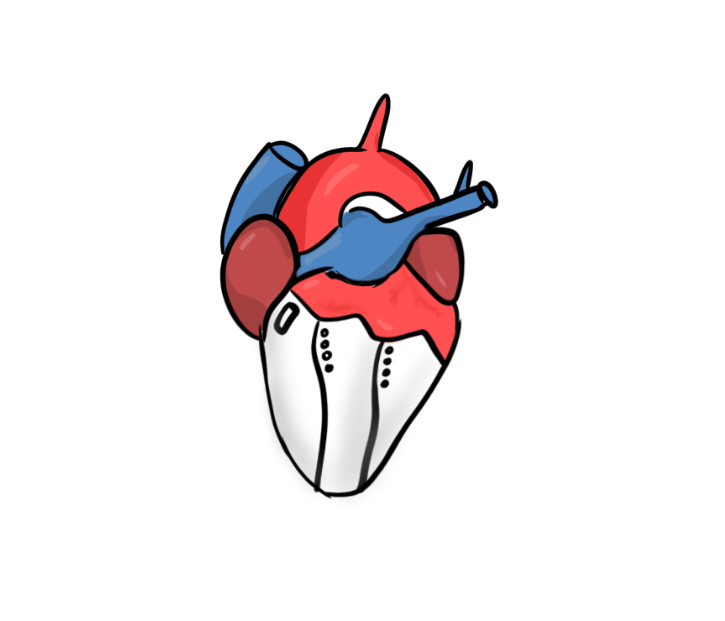
Written By Anoushka Pandya | Art By Anoushka Pandya
Artificial organs are a recent technological advancement that can save many lives. However, with the possibilities of artificial organs come just as many risks. What are artificial organs, and how can they both help and harm?
Artificial organs are human-made tissues or body parts made to replace organs. They are a recent development and replace the need for human donors, of which there has always been a shortage. If a particular body part is not working, an artificial organ keeps our bodies going.
There are three major types of artificial organs:
- Mechanical artificial organs: these are made of plastics and metals
- Biomechanical: these are made of biological material (cells) and plastics/metals. Think of them as an in-between for biological organs and mechanical organs.
- Biological organs: these are made of living cells and biodegradable material.
The concept of artificial organs has raised many concerns about safety and functionality. Since the organ is synthetic, there are worries of immune rejection, where the body rejects the organ, causing damage to the body. There are also worries about organ failure. Because the organs are human-made, there is a chance the organs will stop working. These, among other concerns of cost, ethics, and accessibility, are the challenges this field faces.
However, the benefits of artificial organs outweigh the risks. According to the Health Resources & Services Administration, 103,223 people of all ages are on the Human Organ Donation waiting list. Compared to this amount, the number of donors is much lower. With the development of artificial organs, all these people will be able to receive the organs they need.
Artificial organs are a new and powerful tool. They have the potential to save many lives across the world, but they come with a fair number of risks. However, studies and research continue, and the prominence and safety of artificial organs will increase. Awareness of artificial organs is crucial because of the number of lives they can save. We must encourage research and acceptance!
Works cited:
“Organ Donation Statistics.” Organ Donation Statistics, 2024, www.organdonor.gov/learn/organ-donation-statistics#:~:text=Who%20is%20on%20the%20Transplant,the%20national%20transplant%20waiting%20list.
Rogers, Kristen. “When We’ll Be Able to 3D-Print Organs and Who Will Be Able to Afford Them.” CNN, Cable News Network, 10 Mar. 2023, www.cnn.com/2022/06/10/health/3d-printed-organs-bioprinting-life-itself-wellness-scn/index.html.
MacNeil, Deanna. “Artificial Organs: Innovating to Replace Donors and Dialysis.” The Scientist Magazine®, 20 Jan. 2023, www.the-scientist.com/artificial-organs-innovating-to-replace-donors-and-dialysis-70907.


 pathoscribe
Leave a comment