Written by Diya Desikan | Art by Charlene Cheng
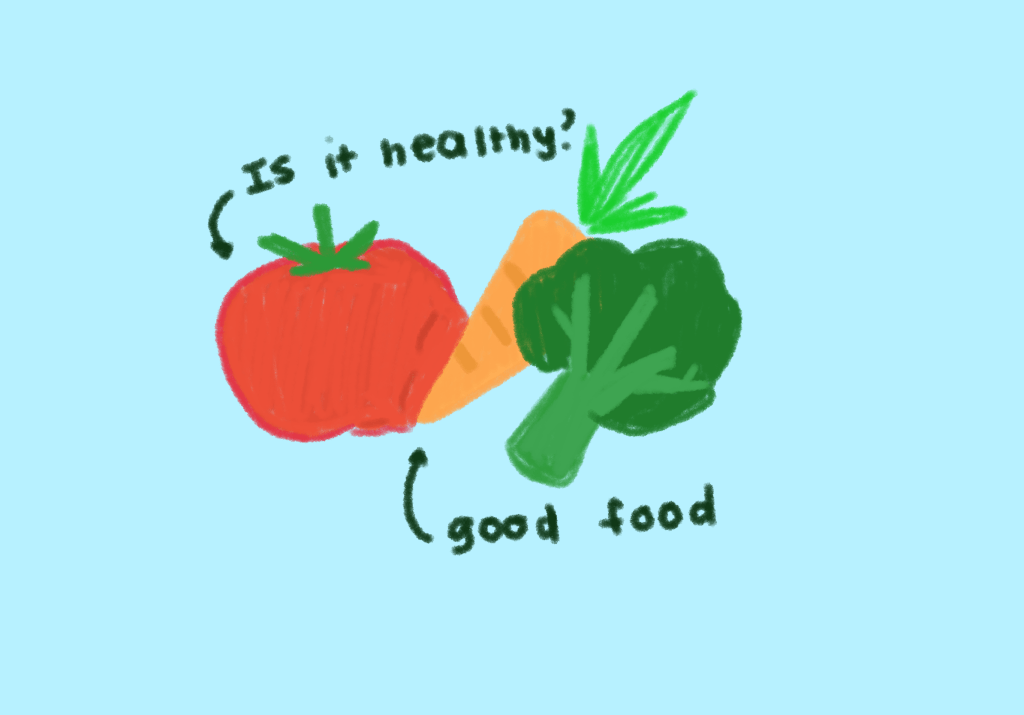
We’ve all encountered those health and wellness influencers, who only eat “clean,” while avoiding various foods and attempting to sell that as healthy eating. Unfortunately, the general public doesn’t realize that much of the information they spread can induce and aggravate a disorder called Orthorexia Nervosa.
Orthorexia Nervosa (ON) is an obsession with eating healthy food, focusing on the quality rather than the quantity of their food (see: Anorexia Nervosa). Nearly 6.9% of the general population is estimated to have ON. It can be debilitating and seriously worsen an individual’s quality of life. Common symptoms include anxiety about food, specifically whether it meets their standard of “healthy or clean,” isolation from activities that may “interfere” with their diet, feelings of guilt when eating “unhealthy,” along with mood swings, depression, and anxiety. Orthorexic behavior shows large similarities to OCD and is prevalent in those with perfectionist tendencies (see article:). People with low self-esteem and body image issues are more prone to orthorexia.
One form of treatment is informing the patients of ON how severe and damaging the disorder is, which may help the patient understand their behavior and actively confront it. More commonly, cognitive behavioral therapy (CBT) is a scientifically backed intervention process, in which patients identify and evaluate their views on diet and food and learn how to cope with their anxiety. Through CBT, patients integrate food groups they may have previously considered “off-limits” and have a more fluid diet, eventually trusting their body’s signals and having a positive relationship with food.
Orthorexia Nervosa has become more prevalent in our society, as with the rise of social media, people who have no background in nutrition can spread incorrect knowledge more easily than before. People fall prey to this knowledge and believe the lies that these influencers spread. We need to be aware of the dangers of false information online and the different ways they can manifest, including Orthorexia Nervosa.
Works Cited:
“What Is Orthorexia Nervosa?” Eating Disorders Victoria, 29 May 2024, http://www.eatingdisorders.org.au/eating-disorders-a-z/orthorexia/.
Scarff, Jonathan R. “Orthorexia Nervosa: An Obsession with Healthy Eating.” Federal Practitioner : For the Health Care Professionals of the VA, DoD, and PHS, U.S. National Library of Medicine, June 2017, http://www.ncbi.nlm.nih.gov/pmc/articles/PMC6370446/#:~:text=Orthorexia%20nervosa%20is%20perhaps%20best,and%20poor%20quality%20of%20life. Scarff, Jonathan R. “Orthorexia Nervosa: An Obsession with Healthy Eating.” Federal Practitioner : For the Health Care Professionals of the VA, DoD, and PHS, U.S. National Library of Medicine, June 2017, http://www.ncbi.nlm.nih.gov/pmc/articles/PMC6370446/#:~:text=Orthorexia%20nervosa%20is%20perhaps%20best,and%20poor%20quality%20of%20life.
 pathoscribe
Leave a comment