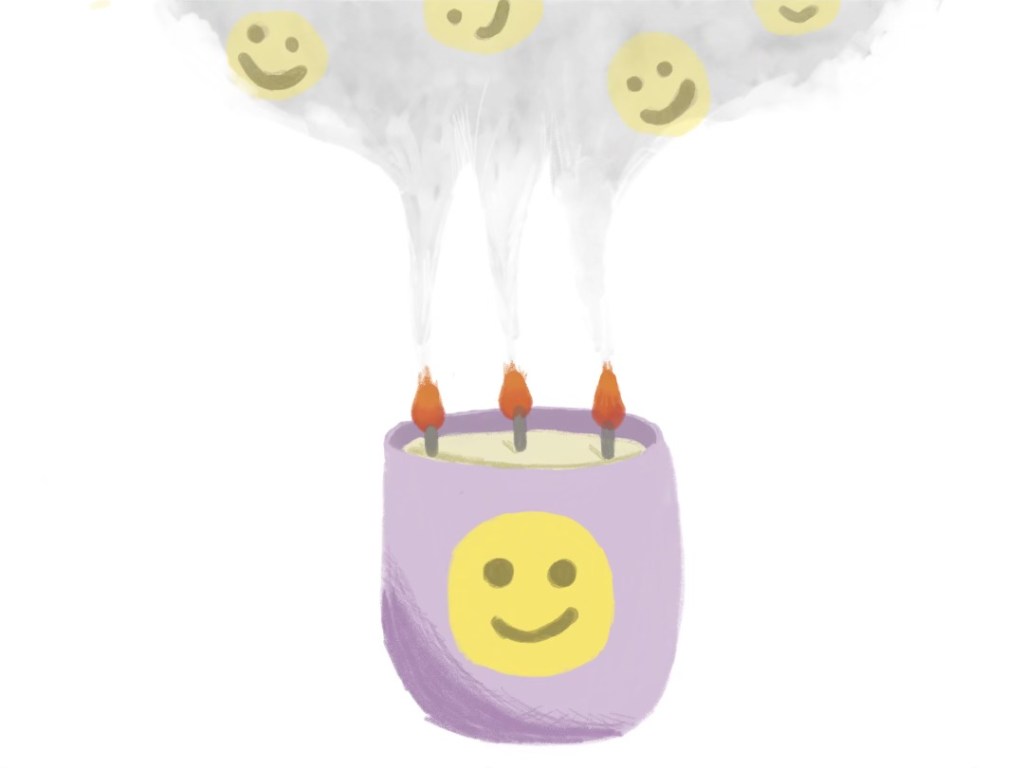
Written by Abigail Lee Aol | Art by Maya Wen
There are exactly five senses present in the human body (although some individuals claim to possess a “really cool” sixth sense). The five main ones are the senses of sight, hearing, taste, touch and smell.
The most undermined among these five is the sense of smell. In fact, many can speak of the numerous times they’ve wished they didn’t have a nose. Most of the time, we inhale odorless air not only because air is inherently odorless, but also since we fail to register certain scents after prolonged exposure to their airborne particles. Olfactory fatigue (nose blindness or odor adaptation) makes it easy to ignore the value olfactory nerves bring to the table.
Olfactory nerves have a direct connection to the amygdala, the center of the brain concerned with emotions. There is ample evidence to show how different scents create different states in the emotional and subsequently physical health of a body. A very basic example is how the aroma of food can trigger salivation and enzyme production or how unpleasant smells can cause stress and even nausea.
The International Arts + Mind Lab and its partners explore “the neuroscience of scents” in a series of rooms with different atmospheres, each intended to “evoke varying emotions and feelings” among guests. Check out their post here.
Aromatherapy therefore involves exploiting our sense of smell to improve our mental and physical well-being. However, not everything that smells nice is good for your health, which is why aromatherapy mainly encompasses essential oils. Concentrated extracts are obtained from different parts of a plant like flowers, leaves, seeds, etc. Some common essential oils include tea tree oil, lavender oil, lemon oil, and peppermint oil.
Although some perfumes may incorporate these essential oils into their formulas, it does not mean that they are safe for use as forms of aromatherapy. Fragrances are very different from essential oils: studies show the adverse effects of their various chemical components, some of which are said to mimic human hormones, thus disrupting the endocrine system.
For therapeutic benefits, quality takes precedence during any and all applications of essential oils. Whether looking to relieve stress or handle insomnia or a mild headache, it is important to ensure that only authentic oils are used.
Essential oils can be applied in various forms of aromatherapy. For example, one could opt for scent sticks or aromatherapy bracelets. These are made with absorbent materials that store essential oils for any time you need a whiff of calming lavender or mood-boosting lemon oil. Scent molecules can trigger the brain’s release of hormones like serotonin, endorphins, and dopamine, which influence “body functions like mood, sleep and digestion.”
When combined with a carrier oil, essential oils can be applied directly on the skin. Since they are already concentrated, they require dilution by another substance to lower the potential of skin irritation. Base oils such as coconut oil and grapeseed oil are often used.
Although studies show that some essential oils can kill a type of Lyme bacteria, results with actual human beings are so widely varied that neither can totally refute or affirm the medicinal credibility of essential oils. Some common discrepancies during studies include the expectation bias, which makes it difficult to determine, for example, whether lavender or the expectation (volunteers have) that lavender will help them relax actually helps reduce their anxiety.
Regardless of the facts and fiction, a world teeming with worries and anxiety needs all the boosts it can get. Aromatherapy remains a scent-sible investment!
Works Cited:
Howard, Megan. “Breathe In: The Neuroscience of Scent.” International Arts + Mind Lab: The Center for Applied Neuroaesthetics, International Arts + Mind Lab: The Center for Applied Neuroaesthetics, 22 May 2019, http://www.artsandmindlab.org/the-neuroscience-of-scent/#:~:text=Based%20on%20a%20review%20of.
John Hopkins Medicine. “Aromatherapy: Do Essential Oils Really Work?” Www.hopkinsmedicine.org, 2024, http://www.hopkinsmedicine.org/health/wellness-and-prevention/aromatherapy-do-essential-oils-really-work#:~:text=Aromatherapy%20is%20the%20practice%20of.
Cleveland Clinic. “Does Aromatherapy Work?” Cleveland Clinic, 21 Sept. 2023, my.clevelandclinic.org/health/treatments/aromatherapy.
“Nose Blindness, Olfactory Fatigue: What Does It Mean?” Healthline, 8 Sept. 2020, http://www.healthline.com/health/nose-blindness.
Zanolli, Lauren. “Why Smelling Good Could Come with a Cost to Health.” The Guardian, 23 May 2019, http://www.theguardian.com/us-news/2019/may/23/fragrance-perfume-personal-cleaning-products-health-issues#:~:text=Three%2Dquarters%20of%20the%20toxic.

 pathoscribe
Leave a comment