Written by Kirsten Batitay | Art by Anoushka Pandya
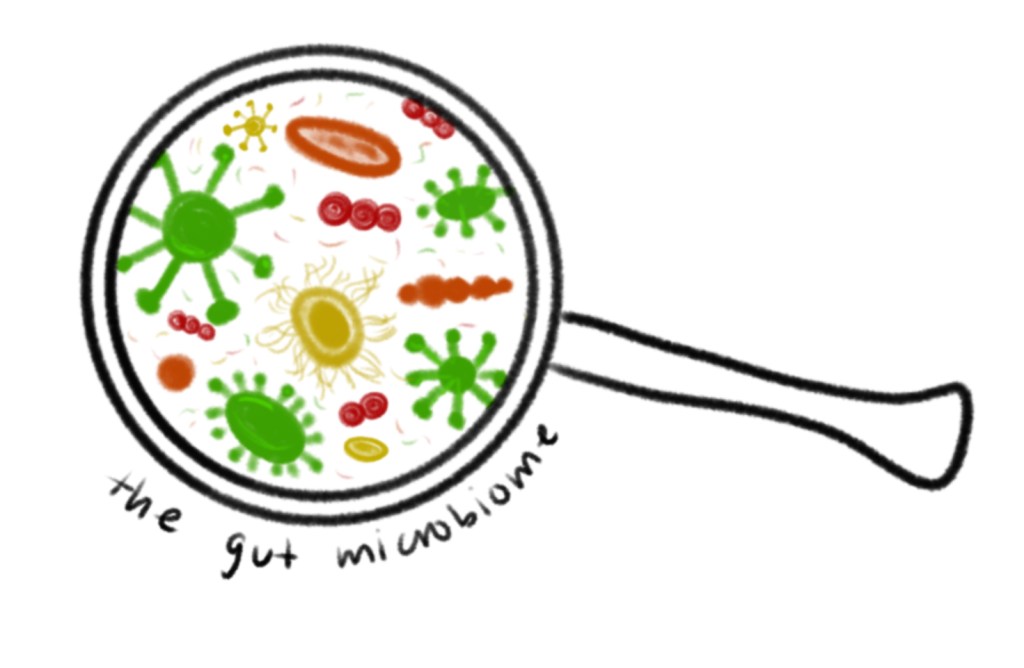
Within our bodies exists an entire ecosystem that thrives and is full of beneficial and harmful organisms. This ecosystem is the microbiome, consisting of trillions of microorganisms like bacteria, fungi, and viruses. Although it exists throughout the body, the largest numbers exist in our small and large intestines, commonly referred to as the “gut microbiome.”
You may ask: what factors determine one’s gut microbiome? Everyone’s unique gut microbiome is initially determined by their DNA. Their first exposure to microorganisms is through the birth canal and the mother’s breast milk. These two factors are what determine the microorganisms an infant is first exposed to, and later factors are environmental exposures and diet.
As with most ecosystems, the gut microbiome can be categorized as healthy or unhealthy. Within a healthy gut microbiome, symbiotic microbiota that benefit both the body and microbiota and pathogenic microbiota that promote disease are balanced and coexist without any problems. When functioning properly, the gut microbiome breaks down potentially toxic foods and compounds, synthesizes certain amino acids and vitamins, and stimulates the immune system. It also protects us from pathogenic organisms taken in by consuming contaminated water or food.
Additionally, when we eat food, sugars are more easily absorbed in the small intestine, and complex carbohydrates like starches and fibers may travel to the large intestine. There, the microbiota break them down using digestive enzymes, and their fermentation releases short-chain fatty acids, or SCFAs. When released, they lower the pH of the colon, limiting the growth of some harmful bacteria. These SCFAs feed the cells in our gut lining and help maintain the gut barrier so that toxins won’t make their way into our bloodstream. Additionally, studies have shown that they may be useful in treating Crohn’s disease and ulcerative colitis.
Despite these benefits, infections, certain diets, or the lengthy use of antibiotics can cause gut dysbiosis, a disturbance in the balance between symbiotic and pathogenic microbiota. This condition may weaken our bodies and cause them to be more vulnerable to disease, which is why it is important to maintain this balance.
You may have heard of or seen the phrase “good for gut health” plastered on countless grocery-store foods or products, and this is related to how diet is an important factor in determining the composition of our gut microbiome. Diversifying your gut microbiome is associated with good health: we can keep it balanced by diversifying the foods we eat, including fermented foods and whole grains while limiting our intake of artificial sweeteners. This is because a diet full of saturated fats and sugar can disrupt your gut microbiome.
Also, we should only take antibiotics when necessary, as they destroy both the bad and good microbiota in our gut microbiome. Prebiotics are also needed to feed our beneficial microbiota, and probiotic foods contain live microbiota that can help alter this ecosystem within us.
Although scientists must still conduct more research to fully understand the microbiome and the consequences of dysbiosis, current research and areas of interest focus on the role of the microbiome in human health and disease as well as how it can be used to help us identify and treat illnesses. These new and exciting possibilities give us abundant hope for what the future of medicine holds and the role of our bodies in keeping us safe from disease and illnesses. Until then, don’t forget to take care of your body, and always try your best to maintain a healthy gut microbiome balance!
Works Cited:
The Nutrition Source Staff. “The Microbiome.” The Nutrition Source, 9 May 2024, nutritionsource.hsph.harvard.edu/microbiome/.
Professional, Cleveland Clinic medical. “What Is Your Gut Microbiome?” Cleveland Clinic, 18 Aug. 2023, my.clevelandclinic.org/health/body/25201-gut-microbiome.
Robertson, Ruairi. “How Does Your Gut Microbiome Impact Your Overall Health?” Healthline, Healthline Media, 3 Apr. 2023, http://www.healthline.com/nutrition/gut-microbiome-and-health#TOC_TITLE_HDR_10.
Shreiner, Andrew B, et al. “The Gut Microbiome in Health and in Disease.” Current Opinion in Gastroenterology, U.S. National Library of Medicine, 31 Jan. 2015, http://www.ncbi.nlm.nih.gov/pmc/articles/PMC4290017/.
Columbia University Staff. “Sugar Disrupts Microbiome, Eliminates Protection against Obesity and Diabetes.” Columbia University Irving Medical Center, 8 Sept. 2022, http://www.cuimc.columbia.edu/news/sugar-disrupts-microbiome-eliminates-protection-against-obesity-and-diabetes.
 pathoscribe
Leave a comment