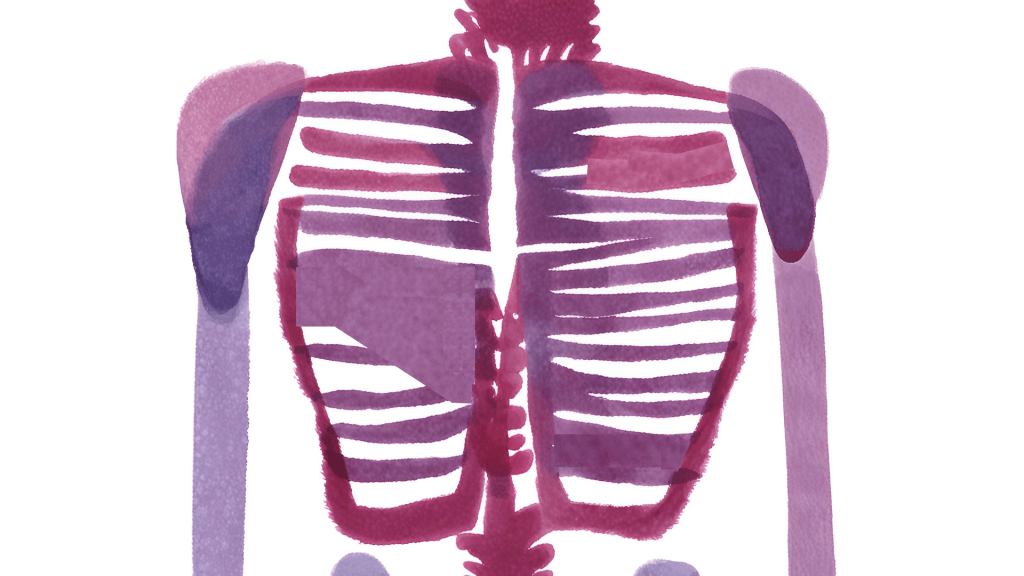
Written by Rihanna Mokhehle | Art by Lily Ozaeta
Fibrodysplasia ossificans progressiva is a rare condition that has harmed many lives. With less than a thousand cases globally confirmed, some still live in pain trying to get the help needed.
Fibrodysplasia ossificans progressiva (FOP) is a rare genetic condition where bone gradually replaces skeletal muscles and connective tissue after birth or progressively through life. Due to this, bones form outside the skeleton and limit movement, which could cause muscle atrophy, leading to many other conditions that could further harm the body. Mutations in the AVCR1 gene are the studied cause for FOP, and the AVCR1 protein is found in many tissues in the body, including skeletal muscle and cartilage. This gene helps with the growth and development of the bones and muscles, also including piecemeal replacement of cartilage by bone that is seen in normal skeletal maturation from birth to young adulthood. That being said, the variants in the AVCR1 gene could disrupt the mechanisms used to control the receptor’s activity. That causes the receptor to turn on when it normally shouldn’t, so too much receptor activity could cause overgrowth in the bone and cartilage, resulting in the signs and symptoms of fibrodysplasia ossificans progressiva.
The symptoms of the condition may include the progressive loss of mobility or episodes of muscle swelling followed by inflammation with rapid ossification that causes trauma to the muscle. Patients may also suffer from difficulty speaking and eating as the mouth is also affected, and it could also affect the neck, back, chest, arms, and legs. While this condition is already quite rare making it hard to diagnose, FOP often mimics other conditions. For example, the early symptoms of FOP such as joint pain and swelling can be similar to those of more familiar conditions like arthritis or muscle injuries, causing a misdiagnosis. Still, there are ways that doctors can identify this.
First, doctors could look out for malformations of the big toes at birth. Genetic testing could also be used because genetic testing helps identify the specific mutation that causes FOP. The condition could also be inherited as FOP is inherited in an autosomal dominant pattern (one copy of the altered gene in each cell is adequate to cause the cell). After fifteen years of research, Federick Kaplan, MD, and Eileen Shore, PhD, discovered the mutation that causes FOP. While a cure might be distant, the research conducted has brought us closer to understanding FOP and developing potential treatments—the hope of a better future for individuals living with FOP fuels our continued efforts.
Works Cited:
Kaplan, Frederick S., et al. “Early Diagnosis of Fibrodysplasia Ossificans Progressiva.” PEDIATRICS, vol. 121, no. 5, May 2008, pp. e1295–300, doi:10.1542/peds.2007-1980.
Case, Amber. “Understanding Limited Range of Motion for Joints.” Integrated Rehabilitation Services, 23 Jan. 2023, integrehab.com/blog/physical-therapy/limited-range-motion-joints.
“Fibrodysplasia Ossificans Progressiva – Symptoms, Causes, Treatment | NORD.” National Organization for Rare Disorders, rarediseases.org/rare-diseases/fibrodysplasia-ossificans-progressiva.
Fibrodysplasia Ossificans Progressiva (FOP) – Symptoms and Causes. http://www.pennmedicine.org/for-patients-and-visitors/patient-information/conditions-treated-a-to-z/fibrodysplasia-ossificans-progressiva-fop.
Fibrodysplasia Ossificans Progressiva: MedlinePlus Genetics. medlineplus.gov/genetics/condition/fibrodysplasia-ossificans-progressiva.



 pathoscribe
Leave a comment