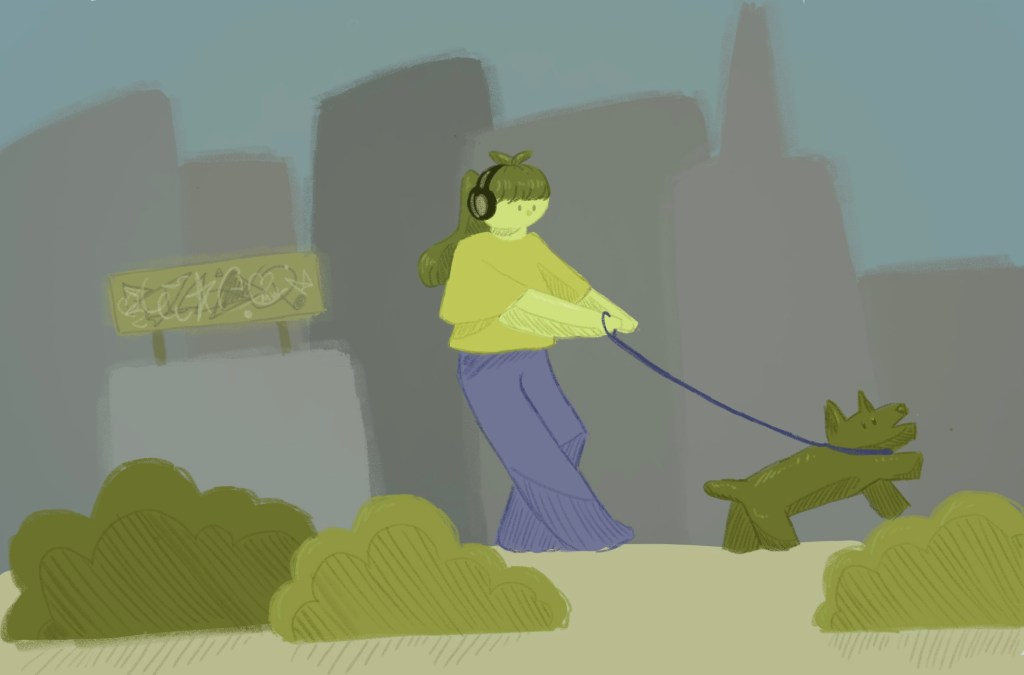
Written by Jayne Thakur | Art by Maya Wen
Often, people assume that having color blindness makes it so that the individual is unable to see any color whatsoever. However, color blindness is a more subtle disorder which involves the inability to differentiate between certain colors as opposed to seeing none at all.
Color vision deficiency (CVD) occurs as a spectrum of vision errors, of which each kind is given a specific name and cause. Complete color blindness, also known as monochromacy or achromatopsia, is rather rare, as it allows for no colors to be seen (vision in black and white).
So what causes color blindness, either partial or complete? The retinas of our eyes contain two vision-identifying components called rods and cones. Rods are responsible for consuming light (meaning they’re more activated when we need night vision or other low-light conditions). Cones, on the other hand, are responsible for recognizing color, which is why there are three types of them: blue light, green light, and red light. An individual with normal vision will have properly functioning neural pathways and electrical signals passing through the cones. However, in some cases, a particular cone is either damaged or is not receiving enough electrical signals to perform its proper function.
As a consequence of having three types of cones, there are different types of partial color blindness, each due to the malfunction of specific cones.
Red-green color vision deficiency is caused by an issue with red and green cones. Individuals with this disorder will have difficulty differentiating between the colors red and green. However, there are four types of red-green color blindness, which is also the most common form of color blindness:
- Deuteranomaly makes green shades look more red(mild).
- Protanomaly makes red shades look more green (mild).
- Deuteranopia makes green look red (severe).
- Protanopia makes red look green (severe).
Another type is blue-yellow color vision deficiency, and its cause depends on which of the two types is being presented in an individual:
- Tritanomaly makes it easy to confuse greens and blues, as well as yellows and reds. This is caused by an absence of the blue-light cone.
- Tritanopia reduces the brightness of the colors and makes it easy to confuse blues and greens, purples and reds, and yellows and pinks. This is caused by reduced sensitivity within all three light cones.
Complete color blindness is rather rare and creates stark vision difficulties and light sensitivities. As the rarest of all types, it only affects approximately 8% of the world’s population.
Works Cited:
U.S. Department of Health and Human Services. (2023, August 7). Types of color vision deficiency. National Eye Institute. https://www.nei.nih.gov/learn-about-eye-health/eye-conditions-and-diseases/color-blindness/types-color-vision-deficiency
U.S. Department of Health and Human Services. (2024, December 10). Color blindness. National Eye Institute. https://www.nei.nih.gov/learn-about-eye-health/eye-conditions-and-diseases/color-blindness
Types of colour blindness. Colour Blind Awareness. (2022, April 1). https://www.colourblindawareness.org/colour-blindness/types-of-colour-blindness/
Color blindness: Types, causes & treatment. Cleveland Clinic. (2023, March 17). https://my.clevelandclinic.org/health/diseases/11604-color-blindness
 pathoscribe
Leave a comment