Written by Aol Abigail Lee | Art by Maya Wen
“If you are able to, please close your eyes.
Take a deep breath in and a deep breath out.
Relax your shoulders.
Unclench your jaw…”
David Larbi, Mindful Moments
In each and every episode of his podcast, David Larbi starts with this opening. More often than we would like to admit, we find ourselves with clenched jaws and drawn-up shoulders so much so that we forget that our bodies can exist outside of tension.
Many other times, we experience graduated pain and tightness in our muscles, whether from holding a certain position for prolonged periods of time or over-exertion. The most common yet underlooked cause of this is stress. Not bad posture, not too much exercise, but stress!
In many ways, our mental and psychological well-being affects that of our physical. Among these is the muscle tension brought about by stress. Although it may seem far-fetched, your mood and general state of mental ease or dis-ease greatly influence the state of your muscles.
Our mental state often influences our body orientation. For example, contentment and optimism are often characterized by relatively straighter posture, unclenched jaws, and loosely held shoulders. In connection to back pain, stress often inspires poor posture, which could look like anything from slouching to forward head posture. The form our body assumes doesn’t matter as much as how long we spend in that position. It is the long stretch of time spent in a particular position that causes muscle stiffness and rigidity.
In several cases, these long stretches of time happen at night. When we sleep, we are often unable to feel our muscles and end up dealing with the consequences later on in the day.
Aside from that, cortisol (stress hormone) production increases during times of mental and physical distress. This hormone causes muscles to stay in a contracted state, thus contributing to tightness and discomfort.
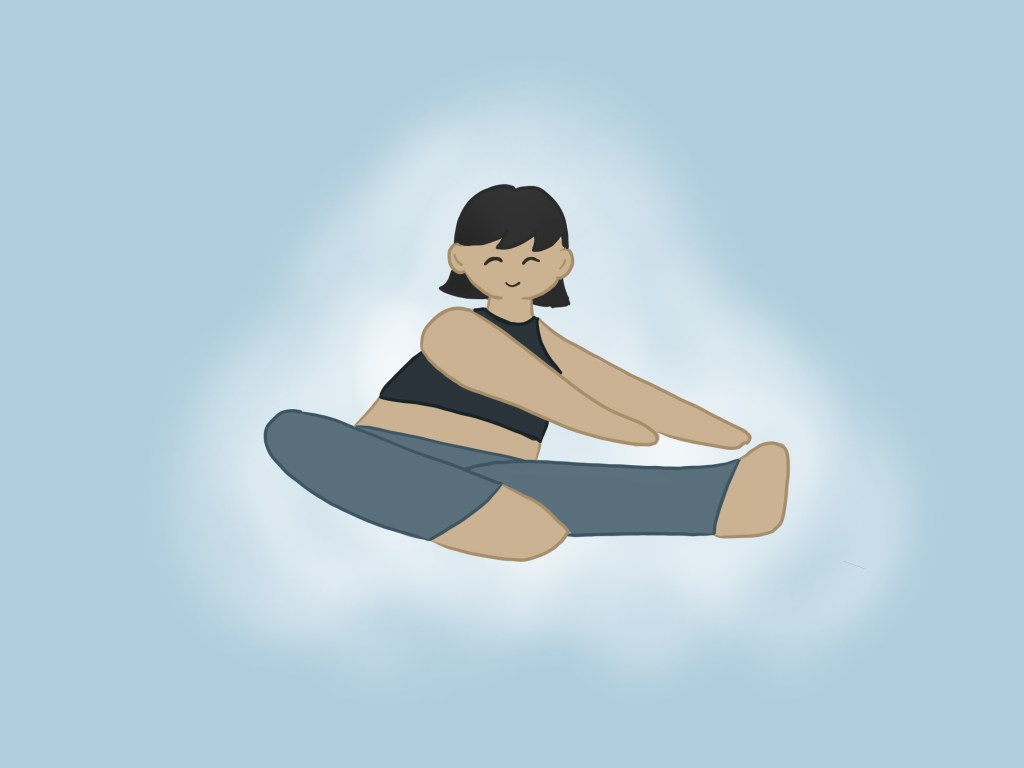
Which is why it is very important to stretch. Stretching helps the muscle tissue to become flexible, and it allows tension relief for the tissue as well. It contributes towards increased blood flow and the removal of waste from muscle cells. For many, stretching is at the bottom of their self-care list. Very few realize how much it can impact our physical and mental well-being.
To stretch is to cause something to reach as far as possible in a particular direction.
However, it is important to be mindful of the limitations of our muscle flexibility such that we don’t end up hurting ourselves in the process, like in the case of overstretching and muscle strain. With this in mind, it is recommended to hold a stretch for about 20 seconds. This can be adjusted depending on your personal judgment on when the “burn” starts feeling more like actual pain than relief. Additionally, it is equally important to know when not to stretch and the difference between a sore or damaged muscle and a tense and tight one.
The main muscle groups in the body include those of the shoulder, arms, calves, chest, abdomen, thighs, and glutes.

Here are a few basic stretches:

The overhead tricep stretch is helpful for relieving tension in the muscles beneath the upper arm that connect the elbow to the shoulder. Here’s a quick step-by-step guide!

The cat cow stretch is beneficial for the great expanse of muscles covering the back and shoulders. Lower back pain appears as a sharp or dull stabbing pain while upper back pain is described as a feeling of tightness or pressure between shoulder blades.

Standing quad stretches target the muscles at the front of the thighs, helping with tightness brought about by poor posture or inactivity. Be sure to try it out here!

For the muscles at the back of the thigh, this stretch as well as the standing hamstring stretch offers relief from too much exertion such as running or long periods spent sitting.
Works Cited:
Harvard Health. “The Ideal Stretching Routine.” Harvard Health, 24 Sept. 2024, www.health.harvard.edu/staying-healthy/the-ideal-stretching-routine.
Pedersen, Traci. “Can Stress Cause Back Pain?” Healthline, 19 Apr. 2023, www.healthline.com/health/therapy-for-stress.
Pmp, Katharine Chan MSc, BSc,. “Can Stress Cause Back Pain?” Verywell Mind, 31 Dec. 2022, www.verywellmind.com/can-stress-cause-back-pain-6133221.
“Chronic Stress Puts Your Health at Risk.” Mayo Clinic, www.mayoclinic.org/healthy-lifestyle/stress-management/in-depth/stress/art-20046037.
“Stress Effects on the Body.” https://www.apa.org, 8 Mar. 2023, www.apa.org/topics/stress/body.
Kastner, Jami, and Andresrimaging/iStock/Getty Images. “Stretches for the Eight Major Muscle Groups.” Livestrong.com, 26 July 2011, www.livestrong.com/article/501662-stretches-for-the-eight-major-muscle-groups.
Williams, Laura. “The Absolute Best Way to Stretch Every Muscle You Have.” Thrillist, 6 Oct. 2016, www.thrillist.com/health/nation/best-stretches-back-shoulder-hamstring-leg-hip-flexor-stretches.
“ACSM Blog.” ACSM_CMS, 18 Mar. 2021, www.acsm.org/blog-detail/acsm-certified-blog/2021/03/18/stretching-and-flexibility-guidelines-update.
(185) David Larbi – YouTube. www.youtube.com/@davidlarbi_.
 pathoscribe
Leave a comment