Written by Kirsten Batitay | Art by Maya Wen
We hear ad nauseam that exercise is the key to a healthy body, and it isn’t just an empty saying. But before speaking about the exciting effects of exercise on the body, we have to first speak about what exactly it does.
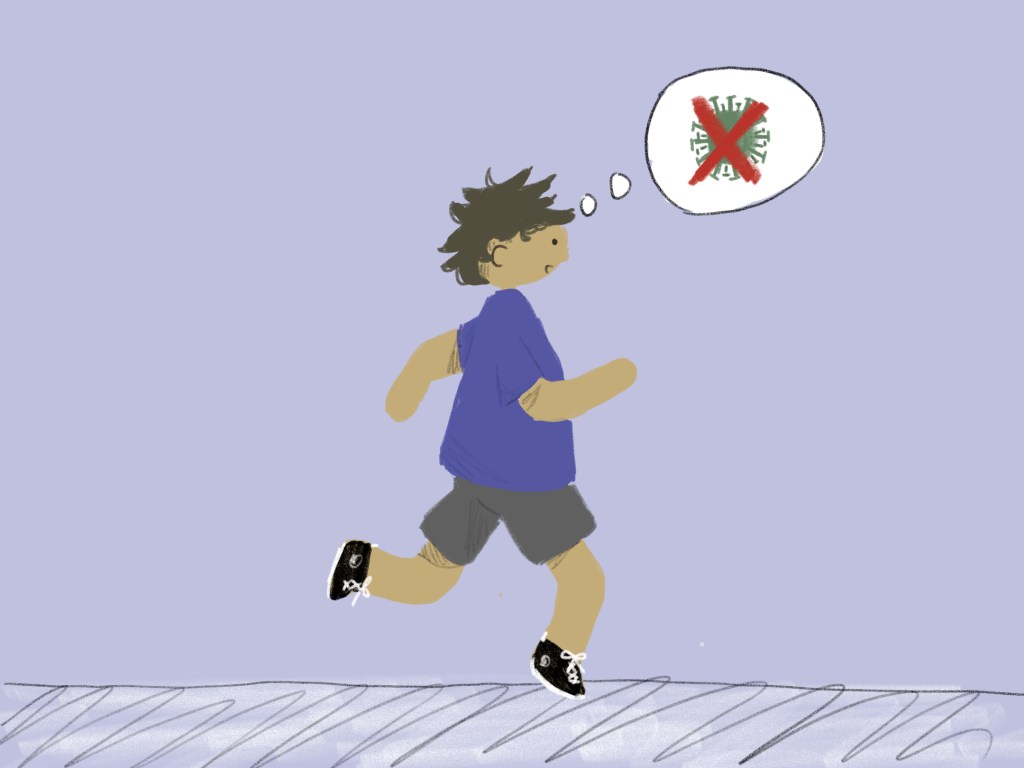
First and foremost, exercise increases your heart rate, which causes more blood to be pumped and oxygen to be delivered to the lungs and other working tissues. When we exercise, blood and lymph (a fluid containing white blood cells) move internally throughout the body. With this in mind, a current but yet-to-be-proven theory states that exercise leads to changes in our bodies’ white blood cells and antibodies, so with moderate exercise, such immune system cells circulate more rapidly. Because they circulate more rapidly, they would be better able to detect illness. Typically, these cells last up to three hours, so consistent exercise means that these cells have more time to survey for any viruses and bacteria.
Returning to an earlier point, exercise improves the muscles’ ability to take oxygen out of blood, which lowers the heart’s need to pump more blood into the muscles. Such benefits include that exercise lowers blood pressure and improves heart health, as well as decreases the risk of acquiring diseases like type II diabetes and heart disease. The more well-known effect of causing weight loss also helps to combat the risks of obesity, and subsequently of diseases like the aforementioned.
In addition, on top of these other benefits, exercise can boost your mood through the release of endorphins, hormones that boost one’s mood and serve as the body’s natural painkillers. Research has shown that with moderate aerobic exercise, the amount of slow-wave sleep (the deepest sleep) you get increases, also improving your sleep.
Without a doubt, exercise has its benefits, but we should take care not to over-exhaust our bodies. Moderate exercise is the kind of exercise recommended to most people, so whether it be simple steps such as choosing to take the stairs instead of the elevator or walking to school instead of driving, these small habits combined with some vigorous workouts here and there build up over time and go a long way.
Works Cited:
“Exercise and Mental Health.” Better Health Channel, Department of Health & Human Services, 18 Sept. 2015, http://www.betterhealth.vic.gov.au/health/healthyliving/exercise-and-mental-health.
Gundersen Health Staff. “Exercise and Your Immune System.” Gundersen Health System, 12 Oct. 2021, http://www.gundersenhealth.org/health-wellness/move/exercise-and-your-immune-system.
Hopkins Medicine Staff. “Exercise and the Heart.” Johns Hopkins Medicine, 20 June 2024, http://www.hopkinsmedicine.org/health/wellness-and-prevention/exercise-and-the-heart.
Hopkins Medicine Staff. “Exercising for Better Sleep.” Johns Hopkins Medicine, 20 June 2024, http://www.hopkinsmedicine.org/health/wellness-and-prevention/exercising-for-better-sleep#:~:text=Exercise%20also%20raises%20your%20core%20body%20temperature.&text=Elevation%20in%20core%20body%20temperature,decline%20helps%20to%20facilitate%20sleepiness.
Medline Staff. “Exercise and Immunity: Medlineplus Medical Encyclopedia.” MedlinePlus, U.S. National Library of Medicine, medlineplus.gov/ency/article/007165.htm. Accessed 4 Feb. 2025.
Nieman, David C, and Laurel M Wentz. “The Compelling Link between Physical Activity and the Body’s Defense System.” Journal of Sport and Health Science, U.S. National Library of Medicine, May 2019, pmc.ncbi.nlm.nih.gov/articles/PMC6523821/.


 pathoscribe
Leave a comment