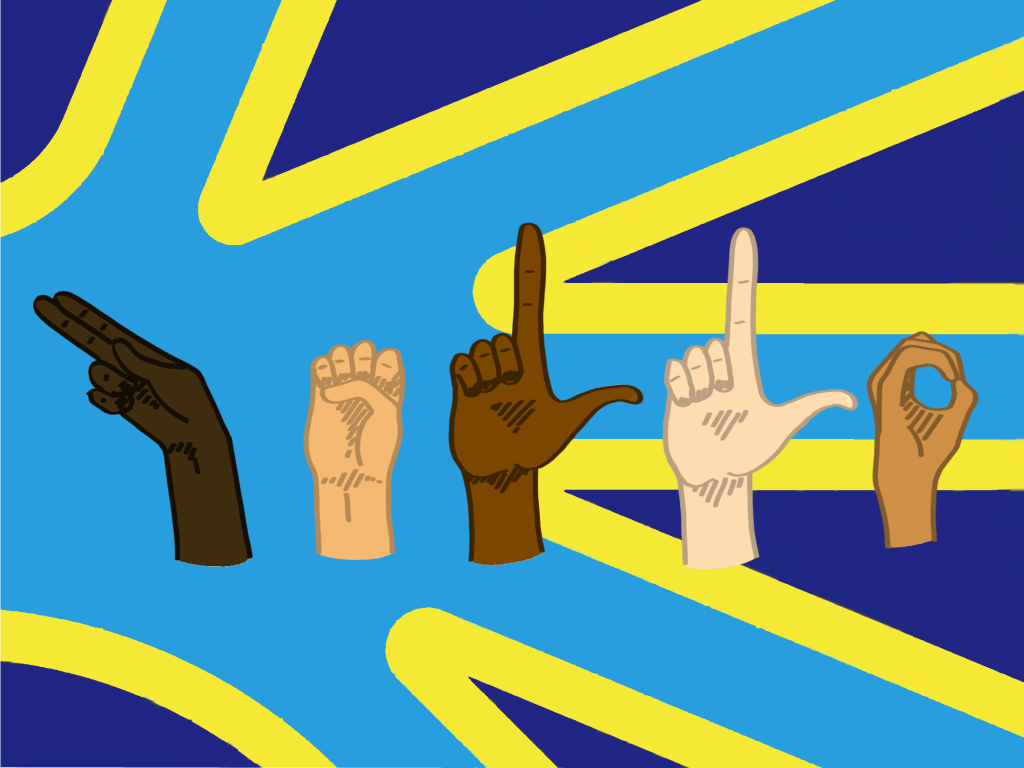
Written by Anoushka Pandya | Art by MollyAnn Caufield
After Rihanna’s 2023 Super Bowl Performance, there was one woman who broke the internet; Not Rihanna, but her sign language interpreter, Justina Miles. Her energetic and passionate interpretation of Rihanna’s music circulated across media networks, where people praised her for her energy and rhythm in conveying the music to deaf audiences. Deaf audiences felt immense pride in Miles and found her performance to be both extremely enjoyable and representative of their community. Her videos went viral, with both hearing and deaf audiences claiming that they couldn’t take their eyes off her the entire performance.
Miles’s performance brought growing awareness to the deaf community and sign language. Sign Language, as defined by Oxford Dictionary, is a “system of communication using visual gestures and signs, as used by deaf people.” Unlike spoken language, sign languages do not rely on words or auditory cues for communication. Sign language also heavily relies on facial cues, whether that be through eye movement, mouth movement, or facial expressions. These facial cues allow for emotions to be expressed and support the message conveyed by the hand signals. For example, facial cues can let the audience know if the message is a question or a statement (eyebrow raise/head tilt), or if the message is something sad or happy (smile/frown).
Contrary to popular belief, sign language is not universal, and varies between countries; In the United States, we use ASL (American Sign Language). There are other variations, such as BSL (British Sign Language), FSL (French Sign Language), CSL (Chinese Sign Language), and more. Sign languages across the globe, however, do share common signs and are often reminiscent of one another. ASL is said to be derived from FSL, and as such, shares many similarities with the language. Like spoken languages, sign language has its own system of grammar and conventions.
Although the Oxford Dictionary defines sign language as “used by deaf people,” sign language is not and should not be limited to the deaf or hard-of-hearing community. In itself, sign language promotes inclusivity and is a means of communication for the deaf community, but this has often been limited to within the community itself. 2.80% of Americans know sign language. It is important that more people, not just in the US, become more acquainted with sign language to promote inclusivity and gain a deeper understanding of the hard-of-hearing community.
Works Cited:
- “American Sign Language.” National Institute of Deafness and Other Communication Disorders, U.S. Department of Health and Human Services, 29 Oct. 2021, www.nidcd.nih.gov/health/american-sign-language.
- Breen, Kerry. “Justina Miles, Deaf Performer Who Went Viral at Rihanna’s Super Bowl Halftime Show, Opens up in First Interview since the Game.” CBS News, CBS Interactive, 18 Feb. 2023, www.cbsnews.com/news/justina-miles-deaf-performer-rihanna-super-bowl-halftime-show-first-interview-snce-game/.
- Duke, Janne-Beate Buanes. “The Complex System of Facial Expressions in Sign Language.” University of Bergen, 26 June 2020, www.uib.no/en/hf/136874/complex-system-facial-expressions-sign-language.
- Mitchell, Ross E, and Travas A Young. “How Many People Use Sign Language? A National Health Survey-Based Estimate.” Journal of deaf studies and deaf education vol. 28,1 (2022): 1-6. doi:10.1093/deafed/enac031


 pathoscribe
Leave a comment