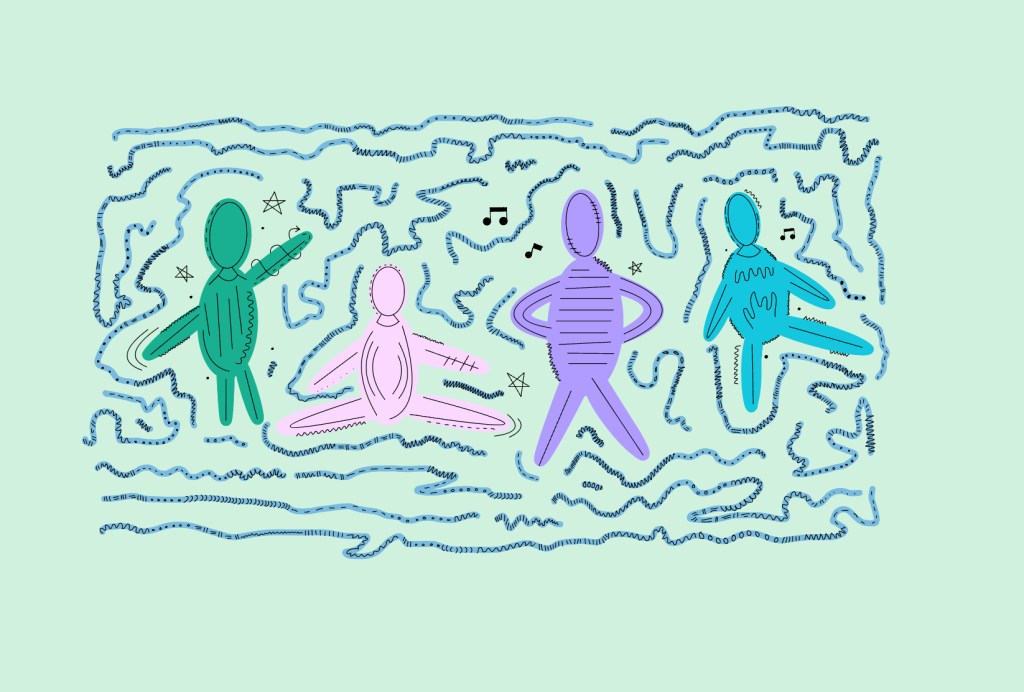
Written By Sanah Punjabi | Art by Tanisha Arora
Regular exercise is widely known to improve one’s physical health in many ways, including but not limited to reducing risk of heart disease, strengthening bones and muscles, and improving sleep.
But what about one’s mental health? Exercise can ease that as well, specifically through the form of dance/movement therapy (DMT).
As defined by the American Dance Therapy Association (ADTA), dance/movement therapy refers to the psychotherapeutic use of movement for the purpose of improving health and well-being. It is a holistic approach reliant on the premise of interconnectivity between mind, body, and spirit.
Biologically, this treatment connects the mind and the body through the involvement of the mirror neuron system in the brain, which is primarily involved in processes of observation and subsequent imitation. This system supports the workings of non-verbal communication. Also involved in dance/movement therapy is the regulation of auditory cortisol, a hormone involved principally with stress. This relationship highlights the integration of music in helping to induce movement and emotion during sessions. Playing into both these aspects of involvement, DMT’s association with motor imagery enhances the mirror neuron system and decreases the cortisol level in order to restore homeostasis in stressful situations.
This treatment strategy has been clinically shown to not only decrease symptoms of depression and anxiety, but also increase quality of life, interpersonal skills, and cognitive skills. Furthermore, DMT has shown promising results in helping with consequences of adult trauma exposure, such as avoidance and dissociative phenomena, and in enabling better stress management through illness acceptance, motor learning, and increased recognition of functional skills.
DMT sessions themselves are not one-size fits all, but there are some common characteristics. Individual sessions often begin with a warm-up, during which the therapist guides the patient through movements, encouraging them to move each and every one of their body parts. This allows the patient to become more aware of their bodily capacity for movement. Group sessions may incorporate elements from a support group or mindful movement class. All these sessions alike incorporate music in order to optimize the effects of the therapy, but each session has its own specialization in terms of age, mental disorders/issues, and services provided.
Visit the ADTA’s website to find a DMT session in your area! https://www.adta.org/find-a-dmt#/
Works Cited
- Admin, ADTA. “What Is Dance/Movement Therapy?” American Dance Therapy Association, adta.memberclicks.net/what-is-dancemovement-therapy. Accessed 3 Aug. 2025.
- “Benefits of Exercise.” MedlinePlus, U.S. National Library of Medicine, medlineplus.gov/benefitsofexercise.html. Accessed 1 Aug. 2025.
- Christopher, Neha, et al. “Full Article: Dance Therapy as an Intervention for Stress and Depression: A Systematic Review and Meta-Analysis.” Taylor & Francis Online, 15 June 2024, http://www.tandfonline.com/doi/full/10.1080/17432979.2024.2377389.
- “Expert Care Experience: Dance/Movement Therapy.” Parkinson’s Foundation, 14 Feb. 2017, http://www.parkinson.org/blog/research/dance-therapy.
- Koch, Sabine C, et al. “Effects of Dance Movement Therapy and Dance on Health-Related Psychological Outcomes. A Meta-Analysis Update.” Frontiers in Psychology, U.S. National Library of Medicine, 20 Aug. 2019, pmc.ncbi.nlm.nih.gov/articles/PMC6710484/.
- Tomaszewski, Crystal, et al. “Impact of Dance Therapy on Adults with Psychological Trauma: A Systematic Review.” European Journal of Psychotraumatology, U.S. National Library of Medicine, 2023, pmc.ncbi.nlm.nih.gov/articles/PMC10334851/.
- Wang, Jingyi. “Neural and Psychological Mechanisms of Dance Movement Therapy Efficacy: Published in Critical Debates in Humanities, Science and Global Justice.” Critical Debates in Humanities, Science and Global Justice, 27 Sept. 2024, criticaldebateshsgj.scholasticahq.com/article/123747-neural-and-psychological-mechanisms-of-dance-movement-therapy-efficacy.


 pathoscribe
Leave a comment