Written by Anoushka Pandya | Art by Tanisha Arora
According to the American Academy of Dermatology Association, 1 in 5 Americans will have some form of skin cancer during their life. As skin cancer is so pertinent, we must understand its signs, treatments, and varieties.
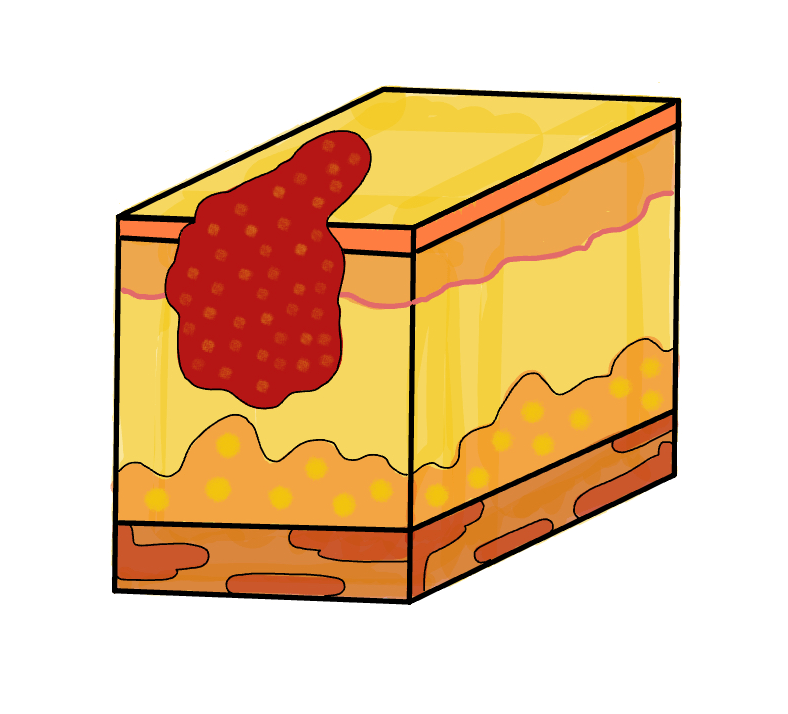
Skin cancer is characterized by uncontrollable cell growth and division of malignant skin cells. Three major types of skin cancer affect the general population.
- Basal Cell Carcinoma, or BCC, begins in the basal cells found in the deepest level of the epidermis. It is the most common type of skin cancer and presents as a skin-colored bump/patch that may bleed, scab, or grow, but not go away, and often evolves.
- Squamous Cell Carcinoma, or SCC, originates in the squamous cells found in the middle layers of the epidermis and usually presents as a red nodule or a sore/raised area on a pre-existing sore.
- Melanoma is the most deadly form of skin cancer and begins in the melanocytes, melanin-producing cells found in the deepest layer of the epidermis. It typically presents as a dark mole or lesion.
Diagnosis of skin cancer involves two steps: A clinical examination and a biopsy. During a clinical examination, a physician will visually examine the suspected cancer. For melanoma, physicians may follow the ‘ABCDE’ method outlined below.
Asymmetry: One half of the mole or lesion does not match the other half.
Border: The borders are irregular, scalloped, or poorly defined.
Color: The mole or lesion has multiple colors, such as brown, black, red, white, or blue.
Diameter: The mole or lesion is larger than 6 millimeters
Evolving: The mole or lesion has changed in size, shape, color, or texture over time.
Dermoscopies often occur during clinical examinations, which are non-invasive techniques in which skin lesions and structures underneath the skin are examined more deeply using a dermoscope.
The next step in the diagnosis of skin cancer is a biopsy. During a biopsy, a sample of tissue is removed from the skin for testing to confirm the type and occurrence of skin cancer. Additionally, skin cancer staging tests can determine the spread of cancer. The stages range from 0 to 4, with an increasing number corresponding to an increase in cancer severity.
Simply put, skin cancer is caused by one main factor: Overexposure to UV radiation. This overexposure is usually from too much time spent in the sun or use of artificial tanning beds (which expose users to unhealthy amounts of UV radiation… so don’t use them!). However, certain factors, like fair skin or a family history of skin cancer, can predispose people to skin cancer.
Skin cancer is complex because it is often mistaken for many other benign conditions (and vice versa). These benign conditions include, but are not limited to, pimples, warts, psoriasis, moles, seborrheic keratosis, and age spots.
BCC and SCC treatment options include surgery (excision, Mohs surgery), curettage and electrodessication (curette scrapes superficial cancerous growth and then remaining cancerous tissue is destroyed with electric currents), radiation therapy, topical creams, and chemotherapy. Of the two, SCC is monitored more carefully because of its increased likelihood of spreading. Melanoma treatment options include surgery (early-stage melanoma), radiation therapy, immunotherapy, targeted therapy, and chemotherapy.
It is important to raise awareness of this condition due to its prevalence and learn how we can protect ourselves from skin cancer. In short: Practice sun safety and stay away from too much UV radiation! Wear sunscreen, avoid excessive sun exposure, and refrain from using tanning beds. Tans are not “healthy glows,” but are rather signs of skin damage! Routinely check your skin for any signs of skin cancer, as it can appear anywhere on the body.
MLA citations (will do later!):
Mayo Clinic. “Basal Cell Carcinoma – Symptoms and Causes.” Mayo Clinic, 12 Apr. 2025, www.mayoclinic.org/diseases-conditions/basal-cell-carcinoma/symptoms-causes/syc-20354187.
Mayo Clinic. “Squamous Cell Carcinoma of the Skin – Symptoms and Causes.” Mayo Clinic, Mayo Clinic, 11 Aug. 2023, www.mayoclinic.org/diseases-conditions/squamous-cell-carcinoma/symptoms-causes/syc-20352480.
Mayo Clinic. “Melanoma – Diagnosis and Treatment – Mayo Clinic.” Mayoclinic.org, Mayo Clinic, 30 Dec. 2023, www.mayoclinic.org/diseases-conditions/melanoma/diagnosis-treatment/drc-20374888.
CDC. “Reducing Risk for Skin Cancer.” Skin Cancer, 16 Apr. 2024, www.cdc.gov/skin-cancer/prevention/index.html.

 pathoscribe
Leave a comment