Written by Srivalli Adarapu | Art by Maya Wen
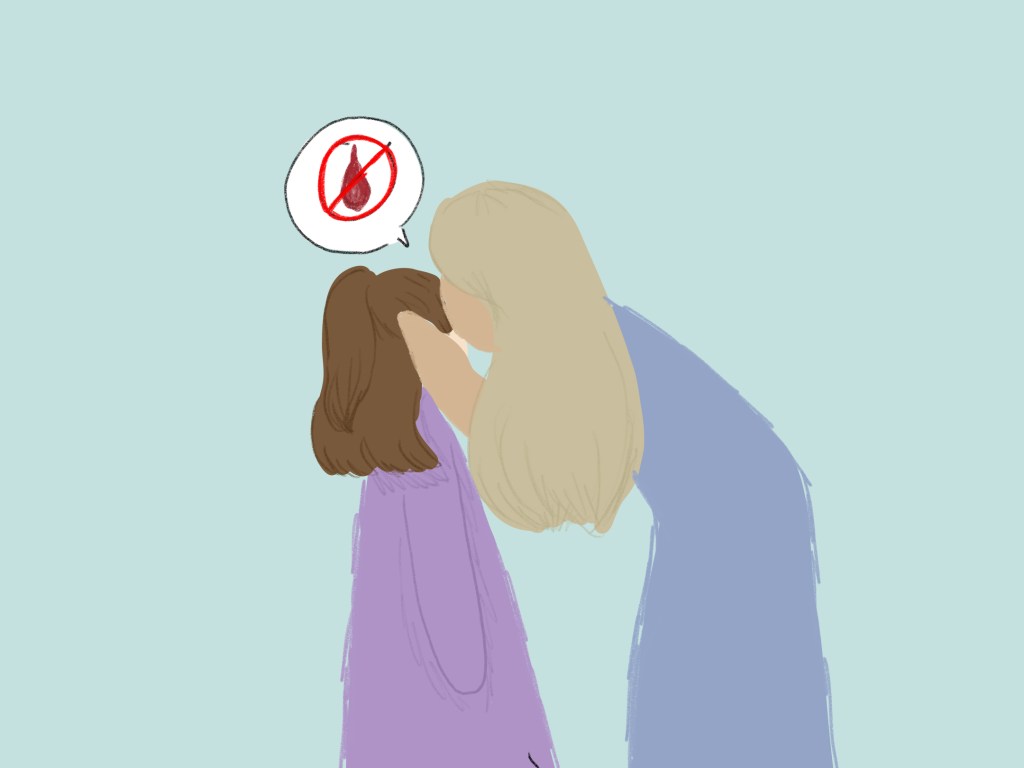
Menstrual poverty disproportionately affects women of low-income and rural backgrounds, directly affecting a woman’s health and education, exacerbating financial struggles. Indigenous women, for example, have a smaller range of menstrual products to select from, and periods and pads tend to be more expensive at local stores like gas stations than at larger department stores found in a more urban area. These differences in prices of menstrual products in rural and urban areas systematically discriminate against rural populations like indigenous populations living in rural areas.
As a result of the high prices of menstrual products, many women switch to more affordable but harmful alternatives, using clothes, newspaper, or paper as pads. These alternatives increase the risk of toxic shock syndrome and other reproductive infections, putting a woman’s health at risk. Women also tend to use menstrual products for longer than recommended and thereby further risking infections and disease.
Menstrual poverty also impacts the personal lifestyle of many women. Due to the unaffordability, some women may skip school, work, and other activities because of the discomfort of alternatives to menstrual products sold in the market. The societal stigma around menstruation allows for menstrual poverty to continue, as many are afraid to seek financial help, as open discussion around periods is discouraged. The United States government has become more aware of this issue and is addressing it. As of 2023, 16 states in the United States were required to supply menstrual products at schools. This article explores two central economic barriers reinforcing menstrual poverty: taxation on menstrual products and the difficulty to enter the menstrual products market.
Economic Barrier #1: Period Taxes
As of January 2024, 21 menstrual products, like pads and tampons, are taxed through the sales tax. These states consider pads and tampons as a luxury item, rather than a necessity. Sales taxes can range from 4-7%, increasing the overall cost of period products. Tax disincentives occur when the addition of taxes to goods discourages consumer spending. To low-income women, the sales tax adds more of a financial burden, discouraging spending on a feminine necessity.
Menstrual products are gradually being seen as health and medical necessities, with Texas being the most recent state as of 2024 to remove sales tax on menstrual products. Feminine products have been priced more than male products, with razors, deodorants, and shampoos marketed for women costing more than those for men.
The executive director of Period Law proposes to change the term of “feminine hygiene products” to “menstrual discharge collection devices” to reframe how menstrual products are perceived, especially by male legislators who may not understand their necessity. This new phrasing classifies periods and tampons as medical products that are regulated by the FDA and IRS. Medical products and necessities are excluded from the sales tax, and period products are also a medical necessity to maintain a healthy and hygienic body.
To eliminate the sales tax for menstrual products that adds a financial burden to many low-income backgrounds, it is essential to reframe tampons and pads as “menstrual discharge collection devices,” or medical necessities, not a luxury item.
Economic Barrier #2: Entering the Market
Nadya Okamoto and Amanda Calabrese are co-founders of 2 companies addressing menstrual challenges relating to access and sustainability of menstrual products. They’ve struggled to run their business, particularly with distributing products due to high barriers to entry. Barriers in the market, specifically regulations and certification costs, prevent smaller companies from entering the menstrual product market, reducing the competition that well-established brands face.
August and Sequel, Okamoto’s and Calabrese’s menstrual-care businesses, for instance, had to wait for FDA approval, which could take years. With the high barriers to entry to the market, businesses struggle to enter the menstrual-care market from the heavy costs and long time required to get certifications and approval. These barriers allow well-established menstrual-care companies like Always and Kotex to have greater power in the market, and consequently, a greater power over the price of highly demanded pads and tampons.
The barriers of entry into the market enable certain companies to monopolize the market and market prices, but also deters innovative and sustainable ideas from entering the market. Since period products are a necessity, regardless of the prices, women from higher or middle-income backgrounds will continue buying the products.
However, the high prices highly discourage low-income women from purchasing menstrual products. By removing these strict barriers of entry into the menstrual-care market, more small companies can compete with the well-established companies supplying tampons and pads, allowing prices to more accurately meet the supply and demand equilibrium.
Works Cited:
Strausfeld, Laura. “This ‘Cringy’ Term Is Helping Defeat the Tampon Tax.” The Washington Post, 22 Feb. 2024, www.washingtonpost.com/opinions/2024/02/22/tampon-name-tax.
Burtka, Allison Torres. “‘It’S a Dignity Issue’: Inside the Movement Tackling Period Poverty in the U.S.” Harvard Public Health Magazine, 5 June 2024, harvardpublichealth.org/reproductive-health/what-is-period-poverty-its-on-the-rise-in-the-us.
York, Alexandra, and Zoya Hasan. “How Two Female-Founded Tampon Companies Use Collaboration Over Competition to Scale Their Brands.” Forbes, 16 Feb. 2024, http://www.forbes.com/sites/alexyork/2024/02/16/how-two-female-founded-tampon-companies-use-collaboration-over-competition-to-scale-their-brands.


 pathoscribe
Leave a comment