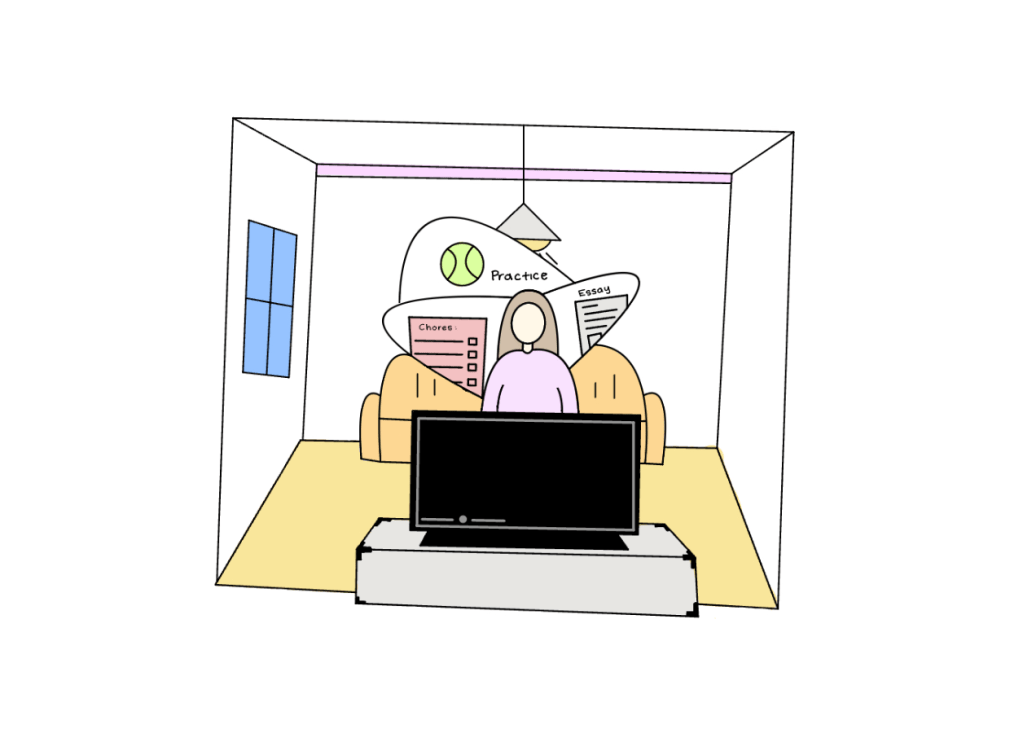
Written by Abigail lee Aol | Art by Tanisha Arora
“I like the state of not interrupting what I’m doing”
Have you ever felt thirsty but couldn’t bring yourself to get water? Or waited until the last minute to make yourself a snack? This could be because you were doing something—reading, scrolling on your phone or literally anything—and you push aside the thirst, hunger, bladder pressure until it reaches a level of discomfort that can no longer be ignored.
Executive dysfunction encompasses this and so much more. To understand this, it’s important to first look into executive functions. These are a set of cognitive processes and mental skills that help individuals manage and regulate their emotions, thoughts and actions.
Some executive functions include:
- Working memory – The ability to work with information over a short period (the “now”). Examples include having conversations, following instructions and remembering what you want to say when called upon. It is distinct from short term memory simply because aside from recalling information, it helps you apply that information to reach a goal like following the recipe to bake yourself a cake
- Cognitive flexibility – Also known as fluid thinking is one’s ability to react to changes in your environment or new information. It allows you to shift from one topic to another and contributes greatly to creativity, innovation and multitasking
- Inhibitory control – One’s ability to resist distractions and maintain focus.
Executive dysfunction therefore refers to difficulties with one or more of these skills. It is commonly associated with Attention-deficit Hyperactivity Disorder (ADHD) and other mental conditions like depression. Degenerative diseases like Alzheimer’s and brain injuries that cause damage to the frontal cortex can also cause executive disorders.
Many individuals can relate to its symptoms which is why it is important to seek professional support when getting a diagnosis and possible treatment paths.
While diagnosis and medication can help address the underlying mental issues from which executive dysfunction can arise, some behavioral changes can also be used to cope.
The first step is identifying which exact executive functions you struggle with. Is it being easily distracted? Difficulty starting a task? Hyperfixating? Or something else? . A really useful and effective strategy to support executive function is creating systems. These must be tailored to an individual’s struggles, needs and goals.
They could look like:
- breaking down tasks
- Using visual reminders
- Setting up the materials needed for a task before hand(e.g., gym clothes, study notes, water on your bedside table)
- Leveraging accountability partners
- Changing your environment for more focus
- Hiding distractions like phones
- Setting alarms to remind you to eat, study etc.
Executive dysfunction can make even the smallest of tasks feel overwhelming but understanding the reason why you struggle with certain activities is the first step towards working through a solution. With self awareness, support and the right system it gets better, bit by bit. Improvement does not look the same for everyone and doesn’t have to happen at once. Small consistent changes lead to a big difference over time.
References
- Kuraska, Grace. “Understanding Executive Functioning: The Key to Success.” University of Bridgeport News, 21 Mar. 2025, www.bridgeport.edu/news/executive-functioning.
- “Executive Function.” Psychology Today, 18 Nov. 2025, www.psychologytoday.com/us/basics/executive-function?msockid=2fc84c68dd1565603bca5880dc156416.
- Alloway, Tracy Packiam, and Evan Copello. “Working Memory: The What, the Why, and the How.” The Australian Educational and Developmental Psychologist, vol. 30, no. 2, Nov. 2013, pp. 105–18. https://doi.org/10.1017/edp.2013.13.
- Kid Sense Child Development. “Working Memory – Kid Sense Child Development.” Kid Sense Child Development, 1 Sept. 2025, childdevelopment.com.au/areas-of-concern/working-memory.
- Professional, Cleveland Clinic Medical. “Executive Dysfunction.” Cleveland Clinic, 29 Oct. 2025, my.clevelandclinic.org/health/symptoms/23224-executive-dysfunction.
- Bilodeau, Nicole. “Executive Dysfunction Explained: How It Affects Daily Life and Practical Strategies for Improvement – Skill Point Therapy.” Skill Point Therapy, 22 Jan. 2025, http://www.skillpointtherapy.com/executive-dysfunction-explained/#Practical_Improvement_Strategies.


 pathoscribe
Leave a comment