Written by Goonj Gautam | Art by MollyAnn Caufield
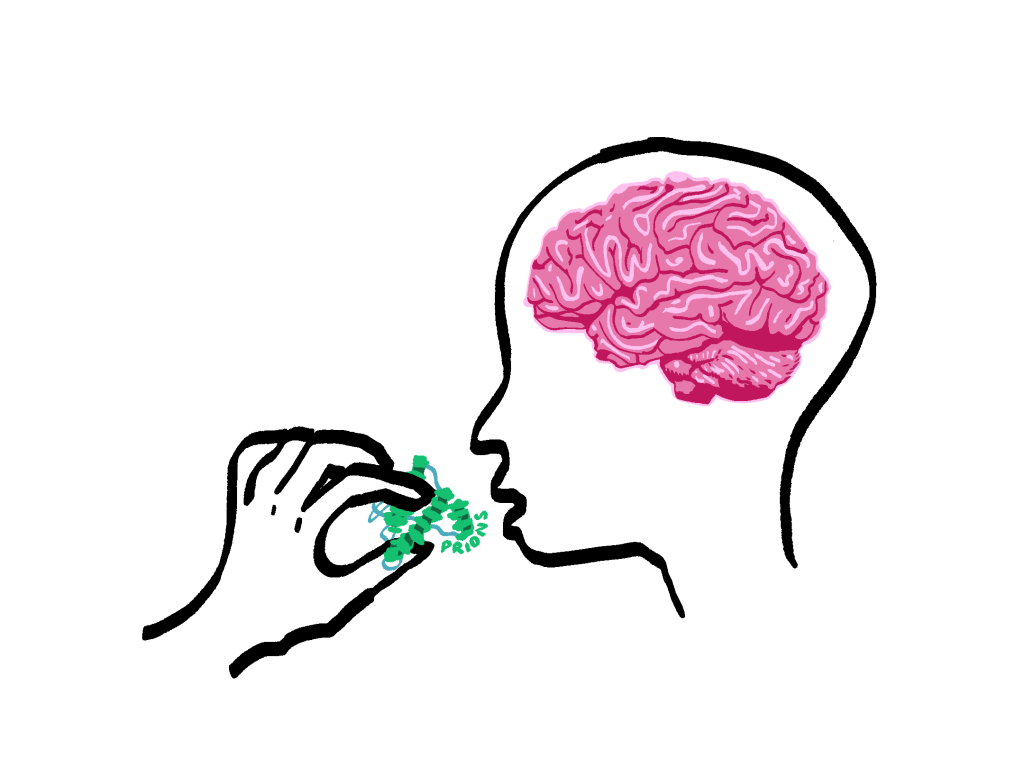
Kuru, a word meaning “to shiver” or “shake in fear”, is a disease that was most prominent among the Fore people in Papua New Guinea. Interestingly, the Fore people performed a type of cannibalism as a funeral rite and ate their dead relatives. This practice continued up until the 1950s, a time when the prevalence of kuru also dropped. Through this practice of endocannibalism, people were infected with kuru by eating the infected brain particles of those who had it as well. Kuru, a rare and fatal neurodegenerative disease, is known as one of the prion diseases. These prion diseases have no known treatment and are known to result in death soon after the symptoms appear.
Because there is no treatment, it can only be prevented, and the best way to do so is not to eat brains infected with prions. Kuru occurs in three stages. Individuals infected with kuru go from experiencing some loss of control over their body in the first stage, to being bedridden and moving involuntarily in the 2nd stage. In the last stage, infected individuals typically lose their ability to speak and may develop other mental health or neurological conditions, such as dementia. Other secondary symptoms, such as the lack of ability to eat or swallow, are usually the ones that lead to death due to malnutrition and starvation. The emotional instability caused by kuru can also lead to sudden outbursts of laughter or crying, leading to its nickname “the Laughing Sickness”.
Diagnosis of kuru will occur through a neurological exam, including an evaluation of the individual’s medical history, cognitive function, blood tests along with tests for other organs as well. Some scans may be ordered, such as an EEG (electroencephalogram) or an MRI (magnetic resonance imaging). However, if kuru is determined to be the cause of the symptoms, palliative care (a type of medical care specializing in reducing the symptoms and pain of those with terminal illnesses) will likely be used. The average time for symptoms to show up after time of infection is 10-13 years, and death can be expected within one year of the first set of symptoms showing up. Thankfully, this deadly neurodegenerative disease is rarely found today and similar symptoms are likely to be of another disease instead.
Works Cited
“Kuru.” Kuru – an Overview | ScienceDirect Topics, http://www.sciencedirect.com/topics/pharmacology-toxicology-and-pharmaceutical-science/kuru. Accessed 24 June 2025.
“Kuru: Medlineplus Medical Encyclopedia.” MedlinePlus, U.S. National Library of Medicine, 10 Nov. 2024, medlineplus.gov/ency/article/001379.htm.
Phillips, Natalie. “Kuru: Causes, Symptoms and Diagnosis.” Healthline, Healthline Media, 31 May 2023, http://www.healthline.com/health/kuru#prevention.
“Prion Disease.” Cleveland Clinic, 2 June 2025, my.clevelandclinic.org/health/diseases/prion-disease.

 pathoscribe
Leave a comment