Written by Ashley Thamaraikkannan | Art by Cailyn Muljadi
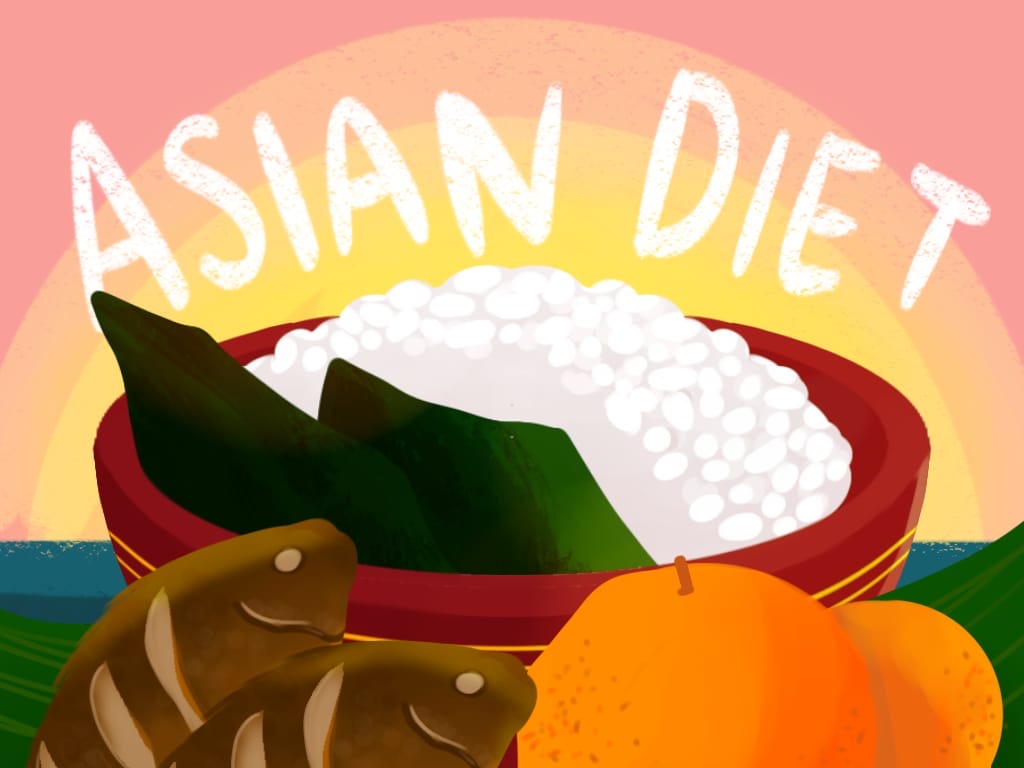
The traditional Asian diet consists mainly of plants and minimally processed foods. This diet varies across different Asian countries but has some similarities. Some staple foods include rice, whole grains, vegetables, and soy products. This diet also has various health benefits, as it’s known for lowering the risk of chronic diseases.
To begin, the theory behind this traditional diet is a combination of cultural, historical, and health principles. It is based on balance, variety, and moderation. This diet also has a great emphasis on plant-based foods and natural ingredients. Aside from the physical parts of the diet, there’s also a mental aspect, such as mindful eating. Meals are eaten slowly, with smaller bites for better digestion. Balance and harmony are part of the Yin-Yang ideology. In traditional Chinese medicine, food is categorized by its Yin (cooling) and Yang (warming) abilities to balance the energy of the body. Additionally, the five elements theory consists of wood, fire, water, metal, and earth. The elements correspond to different organs and parts of the body, promoting health. A plant-based focus is highly looked upon because it’s naturally high in fiber, antioxidants, and vitamins. It also supports digestive health and reduces inflammation. Moderation in animal products is also implemented—compared to Western diets, meat and dairy are consumed in smaller portions, reducing fats and cholesterol.
Meals differ from each country. However, they all implement the same principles. In China, congee (rice porridge) with pickled vegetables and tofu is a typical breakfast. Breakfast in Japan consists of miso soup, fish, rice, and natto. In India, idlis (rice cakes) with sambar (lentil stew) are common. For lunch in China, they typically eat stir-fried vegetables with tofu. In Japan, a bento box with rice and salmon is common. In India, dal (lentil soup) with chapati (flatbread) is typical. For dinner in China, steamed fish with ginger and scallions is common. In Japan, hotpot with tofu and vegetables is common. Lastly, in India, rice with vegetable curry and roti is eaten frequently.
Although there are many benefits to a traditional Asian diet, there can be some drawbacks. They can have high sodium content and high carbohydrates, but are also low in dairy and have potential nutrient deficiencies. However, they are very high in fiber and antioxidants, as well as being low in processed foods and added sugars.
Lastly, this diet is easy to follow because of the variety of foods. One would not be restricted to only a few ingredients. Additionally, there are a variety of cooking methods, such as stir-frying, steaming, and boiling. It is also easily adaptable and balanced. All in all, I would recommend this diet to everyone.
WORKS CITED:
https://www.gicare.com/diets/asian-diet/
https://scottsbluff.legacycoopmsm.com/health_wellness/articles/280/the-traditional-asian-diet-qa

 pathoscribe
Leave a comment