Written by Sameera Rampertab | Art by Tanisha Arora
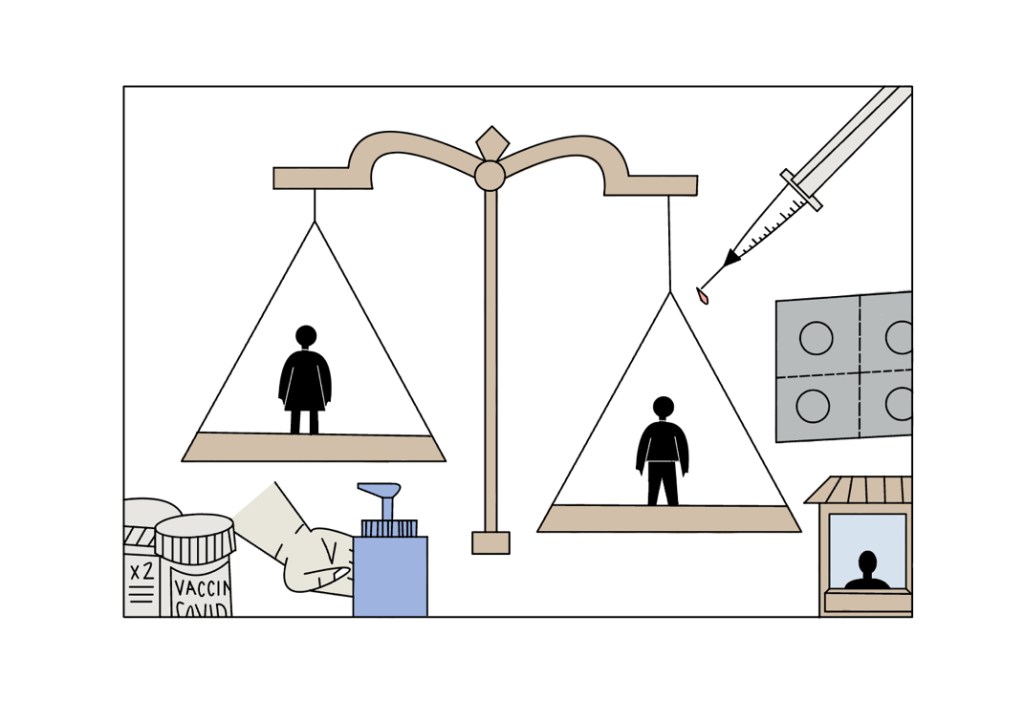
The looming December to February cold and flu season (as identified by the CDC) sparks the question: do men or women possess a stronger immune system? While it may not seem that this is the case since both parties catch illnesses, it was a pertinent factor during the 2020 COVID-19 outbreak when more males contracted the virus than females. Oftentimes, this was blamed on the fact that men are expected to have worse hygiene and habits, such as smoking. Biology, however, plays a significant role in this phenomenon. Additionally, many clinical trials failed to include an adequate number of women, thereby contributing to this misconception. These studies continuously remain flawed because they do not take into account the fact that men have a weaker immune system than women, making them more susceptible to infectious diseases.
Including an equal number of men and women in infectious disease studies is essential to discover the short and long term effects of the disease and what role sex plays. Women and men have different biological responses to pathogens since the female immune system triggers a more intense response. During the early stages of disease, females produce more antibodies, or proteins produced by the immune system to destroy pathogens, than men, ultimately leading to pathogen reduction. Men are more susceptible to contracting infectious diseases because women are protected by the x-chromosome and estrogen. Additionally, hormones maintain a significant role in the strength of both immune systems. Estrogen is an immune activator and testosterone is an immune suppressor. Therefore, since women possess larger amounts of estrogen, their immune systems are more easily activated. Women have a stronger response to bacterial, fungal, and viral infections than men. The female response to autoimmune diseases (diabetes, arthritis, etc.) and cancer is not as strong. However, less attention is paid to the biological difference between men and women. There are approximately ten times more genes on the X chromosome than the Y chromosome. Specifically, the X chromosome carries the Toll-Like Receptor 7 gene aiding in virus detection. Women have the chromosomes XX–while men have the chromosomes XY. Females carry two X chromosomes and have a higher expression of immune-related genes and proteins. These interact with estrogen to intensify the immune response, also amplifying the post-vaccine response during flu season and increasing both adaptive and innate immunity. More cytokines or proteins that regulate the inflammatory response are produced in men during an illness which can worsen the body’s response to infectious disease. Males also express the Toll-Like Receptor 4, a gene which augments pro-inflammatory cytokines, often worsening the severity of diseases. However, T-cells (CD4+ T cells) are more active in females, which reduces the severity of diseases by destroying pathogens.
Therefore, without knowledge of both sexes, it becomes difficult to predict or discover the effectiveness of a vaccine or the severity of a variant. A treatment created without knowledge of both sexes might prove to be ineffective since biological differences play a role in how men and women respond to pathogens. Without knowledge of how the immune system’s response differs between the two sexes, treatments can be too strong for women who are already protected by the X chromosome and estrogen. Treatments can be less effective for men, leading to a greater mortality and severity rate since testosterone acts as an immune suppressor and men only have one X chromosome. Equal samples of data from both sexes must be present to effectively draw conclusions due to the biological differences between both sexes. By collecting equal samples of data, scientists can discover roles that sex differences play in the immune response and develop treatments and vaccines accordingly.
Works Cited:
- Stillwell, R Craig. “Exclusion of women from COVID-19 studies harms women’s health and slows our response to pandemics.” Biology of sex differences vol. 13,1 27. 8 June. 2022, doi:10.1186/s13293-022-00435-1
- Schurz, Haiko, et al. “The X chromosome and sex-specific effects in infectious disease susceptibility.” Human genomics vol. 13,1 2. 8 Jan. 2019, doi:10.1186/s40246-018-0185-z
- Griffith, Derek M, et al. “Men and COVID-19: A Biopsychosocial Approach to Understanding Sex Differences in Mortality and Recommendations for Practice and Policy Interventions.” Preventing chronic disease vol. 17 E63. 16 Jul. 2020, doi:10.5888/pcd17.20024
- Jensen, Adelaide, et al. “COVID-19 vaccines: Considering sex differences in efficacy and safety.” Contemporary clinical trials vol. 115 (2022): 106700. doi:10.1016/j.cct.2022.106700
- Ciarambino, Tiziana, et al. “Immune system and COVID-19 by sex differences and age.” Women’s health (London, England) vol. 17 (2021): 17455065211022262. doi:10.1177/17455065211022262


 pathoscribe
Leave a comment