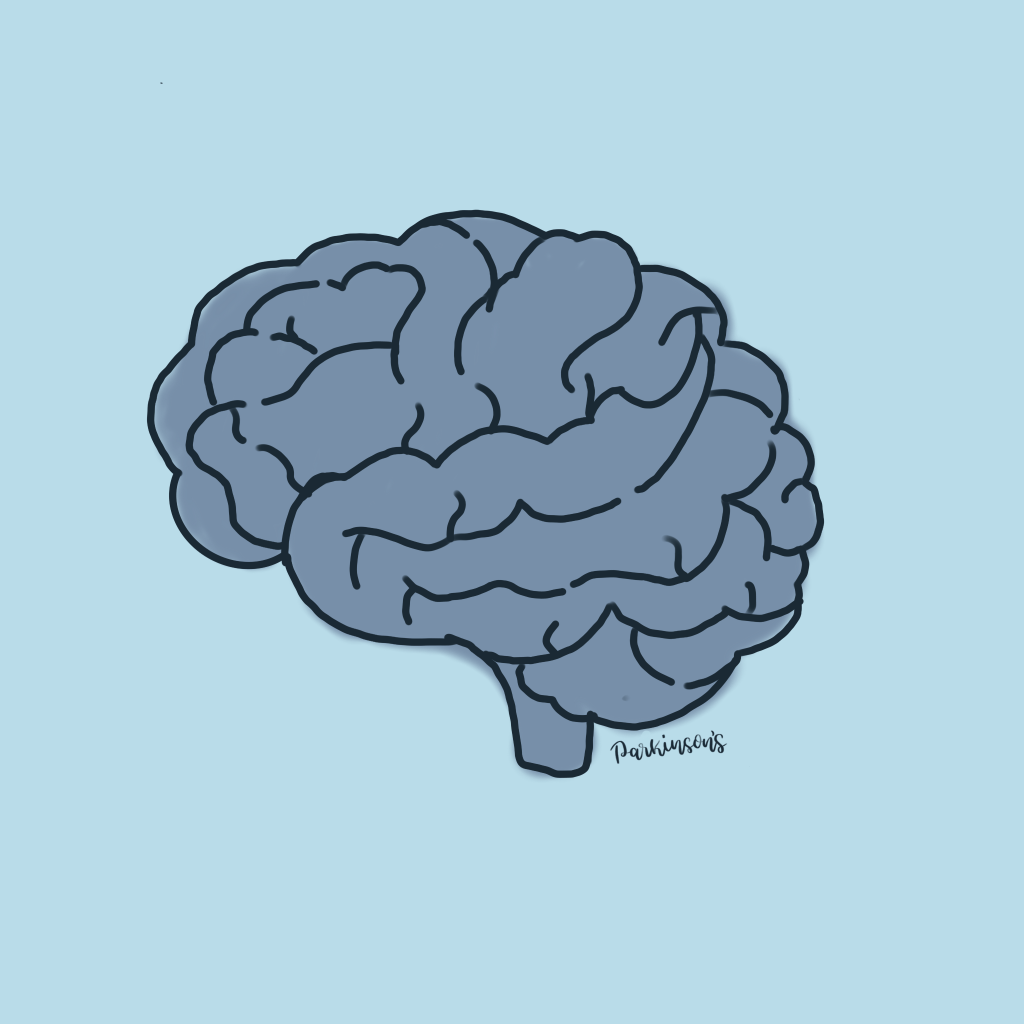
Written by Srivalli Adarapu | Art by Srivalli Adarapu
With over 10 million global cases, Parkinson’s disease ranks as the second most prevalent neurodegenerative disease. Parkinson’s, known to weaken one’s movement by damaging neurons that produce dopamine, has become a global health concern. Beyond weakening the physical body, this disease also impairs the brain. As Parkinson’s disease cases continue to surge, it is paramount to understand this health condition and its effects better.
Parkinson’s is recognized as a diverse disease, impacting individuals uniquely with distinct symptoms. This condition is known to slow the movement of body parts and stiffen up the body. Since Parkinson’s impairs nerve cells responsible for movement, any form of voluntary movement will consequently be difficult. Some individuals enduring this disease experience tremors, especially in their hands, and struggle with balance. Parkinson’s also comes with a variety of psychological and cognitive symptoms. These symptoms include slow thinking, weakened attention span and memory, depression, and anxiety. Symptoms advance and worsen gradually over the years.
Scientists have determined that Parkinson’s results from interactions between environmental and genetic factors. According to the Parkinson’s Foundation, genetics is responsible for 10-15% of Parkinson’s cases. Certain genetic mutations have been attributed to the development of Parkinson’s. Fortunately, Parkinson’s cannot be inherited as it has no genetic link. Moreover, various environmental interactions increase the susceptibility of acquiring Parkinson’s. Head injuries, for instance, have been with the development of Parkinson’s. Exposure to various metals and industrial chemicals such as trichloroethylene (TCE) and PCBs is also associated with Parkinson’s. Pesticides and herbicides are also attributed to this condition.
Unfortunately, once Parkinson’s is acquired, there is no known cure. However, treatments can moderate the progression of Parkinson’s. Although Parkinson’s is not considered fatal, further complications pose a severe threat to one’s life. The Centers for Disease Control and Prevention (CDC) classified complications from Parkinson’s as the 14th leading cause of death in the United States. The diversity in which Parkinson’s affects individuals leads to a variety of treatment opportunities. Medications, exercise, and surgery are common treatment options.
The global understanding of Parkinson’s continues to evolve due to ongoing research. There is still much uncertainty and ambiguity surrounding Parkinson’s disease. Advancements in research will significantly contribute to a better understanding of this condition. As Parkinson’s becomes more prevalent, it is imperative to raise awareness of this condition to cultivate a better public understanding. Together, let’s break down misconceptions and stigma towards this condition and minimize the effects of Parkinson’s.
Works Cited:
Parkinson’s Foundation. “What Is Parkinson’s?” Parkinson’s Foundation, 2024, http://www.parkinson.org/understanding-parkinsons/what-is-parkinsons.
Cleveland Clinic medical. “Parkinson’s Disease: What It Is, Causes, Symptoms & Treatment.” Cleveland Clinic, 2023, https://my.clevelandclinic.org/health/diseases/8525-parkinsons-disease-an-overview.


 pathoscribe
Leave a reply to When Delusion is Not the Solution: Cotard’s Delusion – pathoscribe Cancel reply