Written By Kirsten Batitay | Art by Charlene Cheng
For so long, antibiotics have been our most powerful weapon against bacterial infections. However, things began to change, a major cause being our misuse and overuse of them. Like any organism, bacteria are constantly evolving, leading to disastrous bacterial infections–such as antimicrobial resistance, or AMR. In 2019, there were a reported 1.27 million deaths as a result of AMR bacterial infections. So, what does this mean for us? Antibiotics may no longer be as reliable as they once seemed.
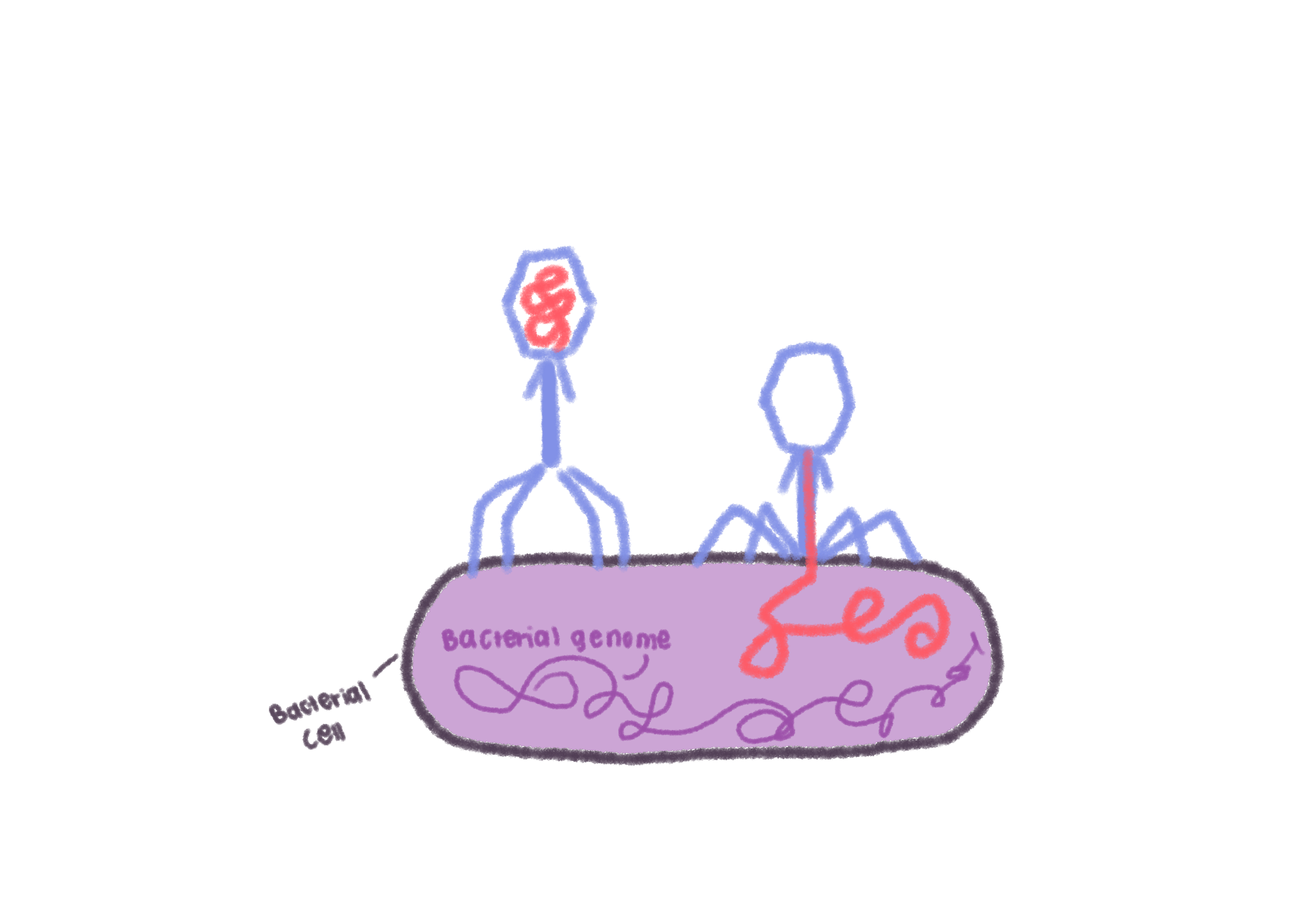
This then provokes another question: If bacterial infections can evolve, what is our next solution? This is where bacteriophages, or simply phages, can be an answer. Phages are viruses that target a specific bacteria and perhaps some close relatives, essentially genetic material enclosed in a husk. When they attach themselves to the bacterium, it is forced to produce new parts of that phage. As the bacteria is filled with phages, this process eventually causes the bacteria to expel its insides and die, so new phages are free to renew this cycle.
Phage therapy focuses on injecting these phages into our bodies to treat AMR bacterial infections, and it is especially good for managing multi-drug, or MDR, resistant bacteria. Despite concerns surrounding this procedure, it is important to note that humans are immune to phages, and they even exist within us. This proves to be a sharp contrast to the fact that antibiotics destroy both harmful bacteria and the microbiota in our gut.
Given these reasons and our current circumstances with antibiotics, it might be a wonder as to why phage therapy has not yet been approved by the FDA, except for compassionate use, an emergency wherein there are no other approved treatments available. This is because clinical trials have not yet been conducted to show its efficacy. However, there is currently one underway for cystic fibrosis patients.
Another obstacle to the facilitation of widespread use of phage therapy is that identifying phages to treat an infection is a lengthy process that involves testing already existing phages. One study reported that 28 to 386 days is the range between the requested time for the therapy and its actual administration. In preparing phages, the usual process of infecting the bacterial host occurs to create a “high-titer” phage mixture, so it must be ensured that the toxins and DNA are removed before the phages can be injected into a patient’s bloodstream.
Even with the many precautions that must be taken to ensure a safe treatment, phage therapy proves to be a hope in the future of treating bacterial infections. In some cases, the bacteria modify themselves to resist phages, compromising their immunity to antibiotics. This allows for the use of phage therapy in combination with antibiotics and boosts the treatment’s efficacy. Dr. Steffanie Strathdee, Associate Dean of Global Health Sciences at UCSD, has stated that the FDA has been “on board” with phage therapy, which could hopefully mean a new branch for medical treatment, at least in the US.
Sources:
“Phage Therapy: Past, Present and Future.” ASM.Org, asm.org/articles/2022/august/phage-therapy-past,-present-and-future. Accessed 19 Aug. 2024.
“The Deadliest Being on Planet Earth – The Bacteriophage.” YouTube, YouTube, http://www.youtube.com/watch?v=YI3tsmFsrOg&t=31s. Accessed 19 Aug. 2024.



Leave a Reply