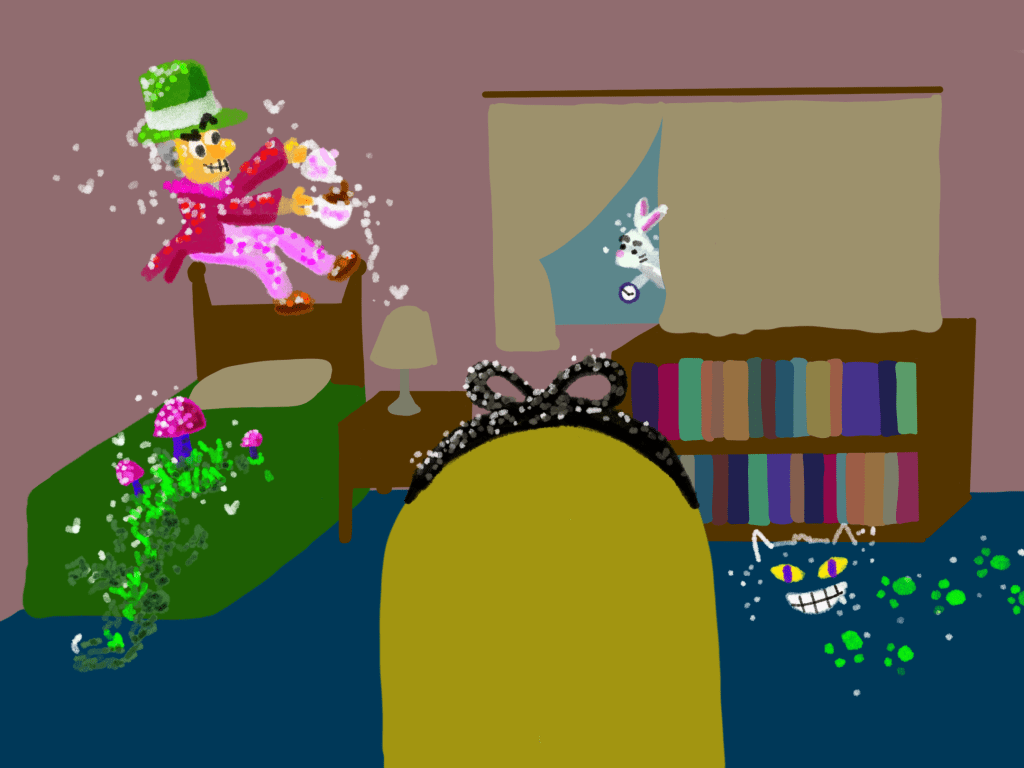
Written by Goonj Gautam | Art by MollyAnn Caufield
The famous children’s book, Alice’s Adventures in Wonderland, written by Lewis Carroll, has sold over a 100 million copies. In fact, the children’s novel inspired the name of a disorder called Alice in Wonderland Syndrome (AIWS) because of its uncanny similarities to the symptoms. In the novel, the main character, Alice, falls through a rabbit hole into the fantasy world of Wonderland, where she experiences distortions in body size and time, depersonalization and derealization, and more. The unusual disorder changes the brain’s ability to correctly process sensory input, whether temporarily or more permanently.
However, the disease is so rare that many physicians aren’t even aware of it, and there’s little available research on it. In fact, less than 1% in the general population has this rare neurological disorder, with about two-thirds of cases occurring in those younger than 18. It’s also more likely to occur in patients with epilepsy, brain tumors, or certain brain-related conditions. Many experts agree that because of the lack of criteria that exists for AIWS, it’s likely underdiagnosed or misdiagnosed often, so the exact prevalence of it is unknown.
So, what causes this odd disorder? While the exact root of it hasn’t been pinpointed yet, specific circumstances and conditions are now known to cause AIWS. The most common of these are migraines (like with a migraine aura), infections (the most likely being Epstein-Barr Virus), seizures, specific types of strokes, and more. Even though the disorder can occur with contagious infections, AIWS itself is not contagious.
The symptoms of AIWS have been categorized into three different sets: self-perception disturbances, visual processing disturbances, and combined symptoms from the previous two. For the first category, the symptoms display distractions in the individual’s brain’s ability to perceive their own self correctly. These symptoms include characteristics like derealization (sense of detachment from their surroundings), depersonalization (sense of detachment from their own body), changes in self-perception (it can be specific body parts or the entire body seen as unusually large or small), or feeling the left and right sides of their body independently of each other. In the second category of disturbances in visual processing, the symptoms typically affect how the individual sees their surroundings, resulting in characteristics like changes in size, distance, object appearance, and more. The third category is a combination of symptoms from the first two, resulting in distortions in the body of oneself and their surroundings.
The diagnosis and treatment of AIWS typically differ between healthcare providers. Generally, the diagnosis will include a questionnaire for the symptoms and neurological exams. Most tests to diagnose AIWS are looking for the underlying cause, so typical tests will include imaging tests (such as CT scans or MRIs) to look for potential issues in your brain, spinal taps to find signs of infection, an electroencephalogram (EEG) to analyze the brain’s electrical activity, and visual evoked potentials to check eyes and optic nerves.
While patients are given medication to suppress hallucinations and delusions for other disorders, in the case of the Alice in Wonderland Syndrome, the treatment will differ from person to person because the goal is to treat the underlying cause. While AIWS lasts for different spans of time for different people, it is usually short-lived and episodes may last for a few minutes to a few hours.
It is difficult for researchers and experts to learn more about AIWS with the disorder being temporary as well as rare. This results in possible underdiagnosis and misdiagnosis because of likely systematic neglect of individual symptoms along with multiple international classifications not even including the syndrome. It is interesting, however, that Lewis Carroll himself, the writer of Alice’s Adventures in Wonderland, likely had Alice in Wonderland Syndrome due to his reports of migraines and vivid descriptions of the symptoms in his famous novel. Curious, isn’t it?
Works Cited
“Alice in Wonderland Syndrome (AIWS): Symptoms & Treatment.” Cleveland Clinic, Cleveland Clinic, 2 June 2025, my.clevelandclinic.org/health/diseases/24491-alice-in-wonderland-syndrome-aiws.
Blom, Jan Dirk. “Alice in Wonderland Syndrome | Neurology Clinical Practice.” Neurology Journals, Jan. 2016, http://www.neurology.org/doi/10.1212/CPJ.0000000000000251.
Upham, Becky. “All about Alice in Wonderland Syndrome.” Edited by Jessica Baity, EverydayHealth.Com, Everyday Health, 10 Dec. 2023, http://www.everydayhealth.com/migraine/interesting-facts-about-alice-in-wonderland-syndrome/.
Weissenstein, Anne, et al. “Alice in Wonderland Syndrome: A Rare Neurological Manifestation with Microscopy in a 6-Year-Old Child.” Journal of Pediatric Neurosciences, U.S. National Library of Medicine, 2014, pmc.ncbi.nlm.nih.gov/articles/PMC4302569/.


 pathoscribe
Leave a reply to The Mindful Migraine Blog Cancel reply